FOR IMMEDIATE RELEASE
Ahead of America Recycles Day, research from Busch Systems and other prominent organizations point to the conclusion that bin standards and centralized collections are key indicators of successful waste diversion.
BARRIE, Ontario, November 15, 2026
For more than forty years, the standard approach to improving recycling was to tell people to try harder. New results suggest the better lever is the bin itself.
Research published by Busch Systems, a North American manufacturer of recycling and waste containers, in collaboration with the Association for the Advancement of Sustainability in Higher Education, the College & University Recycling Coalition, the Zero Waste Campus Council, the National Wildlife Federation and Campus Race to Zero Waste, surveyed 170 colleges and universities across the United States and Canada on how they collect waste and recycling from offices and academic buildings.
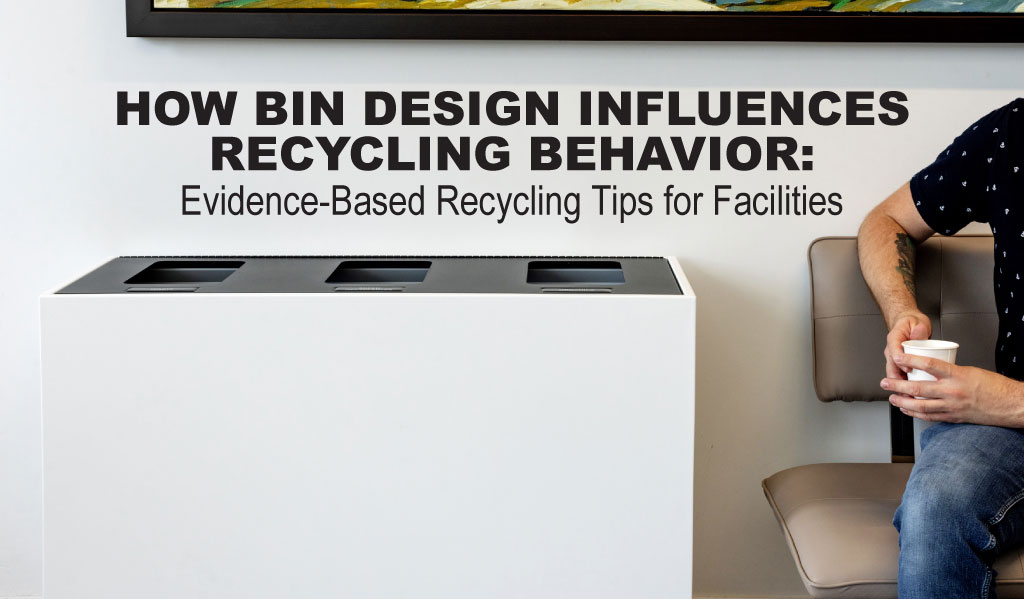
The findings reveal a clear trend toward modernizing indoor waste collections to centralized collection. Among the large four-year American institutions in the sample, more than 66 percent have formally adopted uniform bin and signage design standards, which are shown to help people accurately sort waste. Separately, 44 percent have partially or completely discontinued deskside wastebasket collections from office workstations, and 39 percent have likewise done so from inside classrooms. Schools who’ve implemented this model pointed to improved recycling and waste diversion – 58 percent from office deskside locations, 74 percent from classrooms – as well as labor savings – 86 percent from office deskside and 93 percent from classrooms.
Most notably, the schools performing best were the ones that had made these changes. Institutions that recycle or otherwise divert 40 percent or more of their waste from landfills were 15 percent more likely to have adopted uniform bin standards and 46 percent more likely to have adopted centralized collections in office deskside locations.
Results reported this year at the University of Michigan, which uses standardized Busch Systems containers as part of its campus program, point the same way. According to an article in The University Record, a centralized collection pilot at the university’s Ruthven Administration Building that replaced deskside bins with shared waste stations produced a 20 percent reduction in total waste generated, an 80 percent decrease in recycling contamination and a 28 percent increase in material diverted to recycling and compost, while eliminating roughly 9,000 plastic liner bags per year. Elsewhere on campus, aligning a building with the university’s bin standards was associated with a 70 percent increase in diversion.
“To improve recycling and waste diversion we have to rethink how waste is collected,” said Alec Cooley, Senior Advisor at Busch Systems and author of the report. “This study reinforces how standardized bin design and centralized collection arrangements are fundamental to a modern high-performing collection system that achieves zero waste goals.”
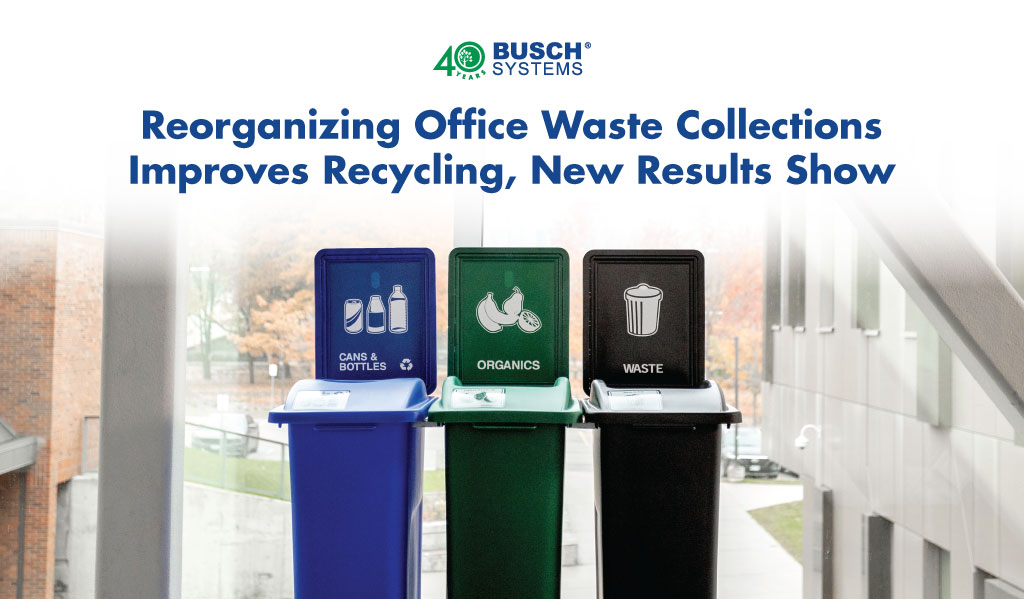
The same principle is being applied to food waste. Studies show that 25 percent or more of the waste generated in office or academic locations can be food or food service packaging. By focusing custodial service on a smaller number of common space locations, centralized collection arrangements make it economical to add a third bin to divert food and related packaging without increasing the overall labor commitment. The survey showed 19 percent of schools had fully integrated dedicated food waste bins to their standard centralized waste stations. And as an indication of the growing trend, an additional 54 percent had either piloted or were actively planning to implement food waste diversion from office and academic areas.
Another example is in Wake County, North Carolina, the SHARE food recovery program run by Toward Zero Waste operates in 47 public schools, recovering an average of 41 unopened items per school each day. Because food safety rules exclude unwrapped fruit from sharing tables, participating schools collect uneaten whole fruit separately in Busch Systems Multi Recycler containers for donation to community food pantries. One elementary school counted 669 uneaten apples and pears discarded over an eight-week period before the change.
Busch Systems, a Certified B Corporation that has manufactured recycling containers in North America since 1985, has also helped fund the collection of 7 million plastic bottle equivalents from the environment since 2023 through its partnership with Plastic Bank.
The full report, Indoor Waste & Diversion at Colleges and Universities, is available at buschsystems.com.
About Busch Systems
Busch Systems International designs and manufactures recycling, waste and compost containers for offices, campuses, healthcare facilities, hospitality and public spaces across North America. Founded in Barrie, Ontario in 1985 and a Certified B Corporation, the company supplies containers made with recycled content and provides diversion program guidance through its team of sustainability advisors.
Media contact
Rebecca Rainey, Manager of Marketing & Brand Experience, Busch Systems
1.800.565.9931
buschsystems.com
###