Recycling is often treated as the final step in waste management. A material goes into the recycling bin, gets collected, and disappears from sight. But what happens next?
Behind every recycled can, cardboard box, and plastic bottle is a system of collection, sorting, processing, and remanufacturing that determines whether a material can become a useful resource again.
For organizations working toward sustainability goals, understanding this process is essential. Schools, offices, airports, healthcare facilities, and other high-traffic environments generate a wide range of recyclable materials every day. The effectiveness of a recycling program depends not only on providing collection bins, but also on helping people sort materials correctly and ensuring those materials can be recovered.
At Busch Systems, we believe effective waste diversion starts with education, thoughtful infrastructure, and consistent practices. Understanding what happens after recycling makes it easier to build programs that keep valuable materials in circulation and reduce the amount of waste sent to landfill.
Here are 10 common recyclable materials, how they are processed, and what they can become.
What Happens After You Put Something in the Recycling Bin?
Before exploring individual materials, it helps to understand the recycling process as a whole.
Although processes vary by material, facility, and region, recycling generally involves four stages:
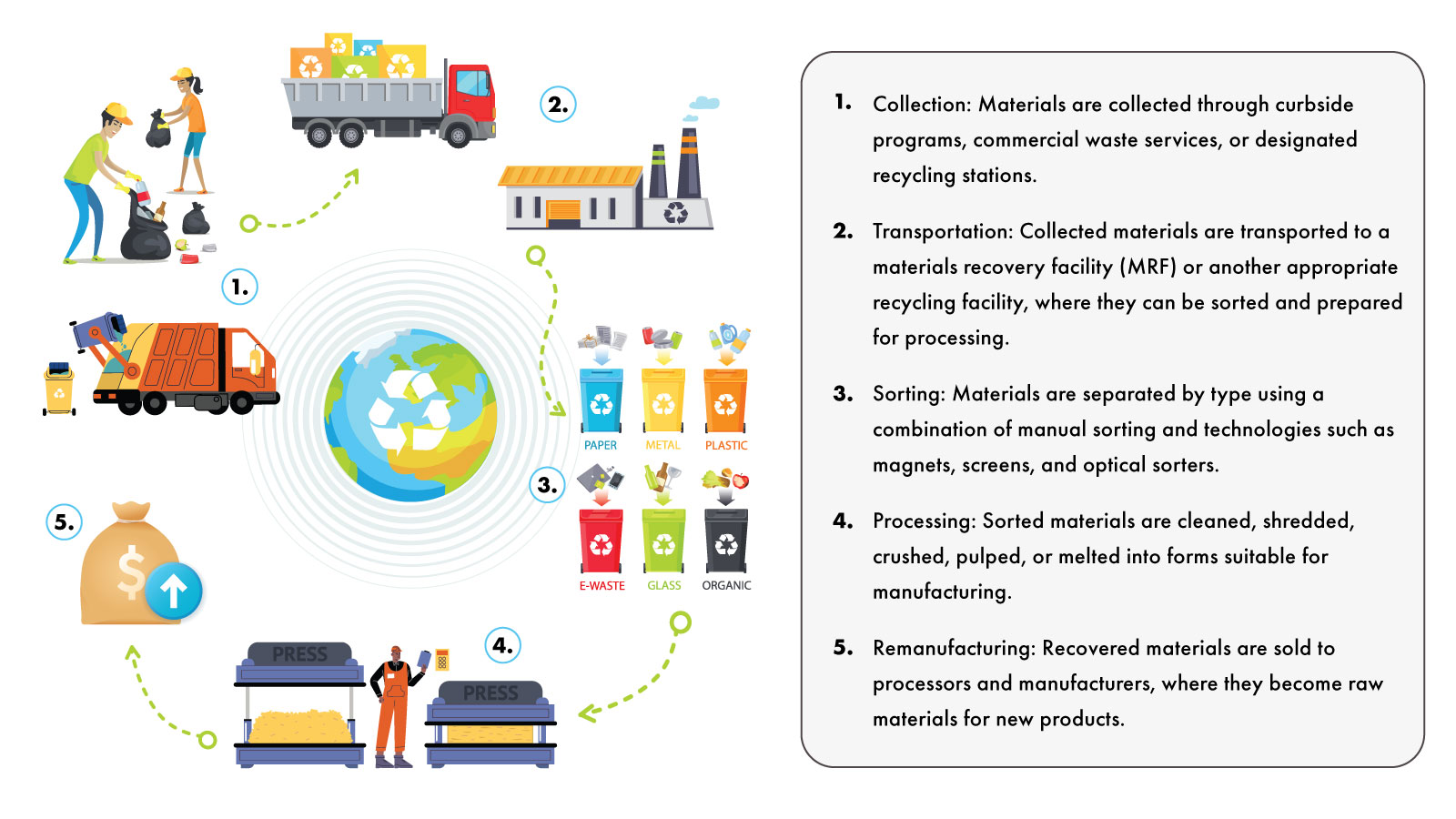
Not every item placed in a recycling bin makes it through all four stages. Contamination, incompatible materials, sorting limitations, and market conditions can affect whether an item is successfully recovered.
According to the U.S. Environmental Protection Agency (EPA), the recycling system connects collection and processing with manufacturing and the purchase of products made with recycled content. This final step helps complete the recycling loop.
10 Common Recyclable Materials and What They Become
1. Paper
Common examples: Office paper, newspapers, magazines, envelopes, and flyers.
Paper is one of the most familiar materials collected through recycling programs, particularly in offices, schools, and administrative environments.
After collection, paper is sorted by grade and transported to a paper mill. There, it is mixed with water to create a pulp. Screening and cleaning remove contaminants such as adhesives, staples, and other unwanted materials. Depending on the intended product, the pulp may undergo additional processing before being formed into new sheets.
What can recycled paper become?
- Printing and writing paper
- Paper towels and tissue products
- Newspaper
- Paperboard packaging
- Egg cartons and other molded-fiber products
Paper fibers become shorter and weaker each time they are recycled, meaning they cannot be reused indefinitely. The quality of the recovered paper and the manufacturing process influence how many times the fibers can be used.
How to improve paper recycling: Keep paper dry and separate from food waste and liquids. Establish clearly labelled paper collection points near printers, desks, classrooms, and shared workspaces. Follow local requirements for shredded paper and coated or laminated materials.
2. Cardboard and Corrugated Packaging
Common examples: Shipping boxes, delivery packaging, and corrugated cardboard cartons.
Cardboard is especially important for businesses that receive regular shipments. E-commerce, offices, retail stores, and educational institutions can generate substantial volumes of cardboard packaging.
What can recycled cardboard become?
- New corrugated cardboard boxes
- Paperboard packaging
- Paper bags
- Paper tubes and cores
- Other paper products
Recycling cardboard helps retain valuable paper fibers in circulation and reduces the need for virgin fiber in manufacturing.
How to improve cardboard recycling: Flatten boxes to save space and remove excessive plastic packaging, foam, and other non-paper materials. Keep cardboard dry and free from substantial food contamination. Place dedicated cardboard collection points near shipping and receiving areas rather than relying exclusively on general-purpose recycling stations.
3. Plastic Bottles and Jugs
Common examples: Water bottles, beverage bottles, laundry detergent jugs, and certain household cleaning containers.
Plastic is not one uniform material. Different resin types have different properties and require different processing methods. As a result, a plastic item’s shape, resin type, color, additives, and local recycling infrastructure can all influence its recovery options.
Common bottle plastics include PET (polyethylene terephthalate) and HDPE (high-density polyethylene).
After sorting, recyclable plastic containers are typically cleaned and shredded into flakes. These flakes may undergo further washing and separation before being melted and formed into pellets or other manufacturing feedstock.
What can recycled plastic become?
- New plastic bottles and containers
- Textile fibers for clothing and fleece
- Carpet fibers
- Plastic strapping
- Selected construction and outdoor products
- New recycling bins and waste containers, including products made with post-consumer recycled (PCR) plastic
At Busch Systems, we incorporate post-consumer recycled (PCR) plastic into select waste and recycling containers, helping give previously used plastic a second life. For example, our Renegade, Outlaw, Waste Watcher, and Kitchen Compost Series are made with PCR plastic, demonstrating how recovered materials can be used to manufacture durable products that support waste diversion programs.
Not every plastic bottle becomes another bottle. Some plastics are downcycled into products with different applications, and others may not be accepted by local programs at all.
How to improve plastic recycling: Empty containers and follow local instructions for rinsing, caps, and labels. Check the accepted materials list rather than assuming every plastic item is recyclable because it displays a recycling symbol. Plastic bags and flexible films often require separate collection arrangements.
4. Aluminum Cans and Foil
Common examples: Soft drink cans, sparkling water cans, and accepted aluminum food containers or foil.
Following collection and sorting, aluminum is separated from other materials, often using eddy-current separation or other specialized equipment. The recovered aluminum is then prepared, melted, and cast into forms suitable for manufacturing. It can subsequently be rolled into sheets or shaped into new products.
What can recycled aluminum become?
- New beverage cans
- Food packaging
- Automotive components
- Building materials
- Other aluminum products
Producing aluminum from recycled material generally requires substantially less energy than producing it from primary raw materials.
How to improve aluminum recycling: Empty cans and place them in the appropriate recycling stream. Check whether your local program accepts aluminum foil and trays and make sure food residue is removed as required. Avoid crushing cans if your local single-stream sorting system advises against it.
5. Steel and Tin-Plated Food Cans
Common examples: Soup cans, vegetable cans, and other steel food containers.
Many containers described as tin cans are actually made primarily from steel with a thin tin coating. Steel is widely used in packaging and construction because of its strength and durability.
What can recycled steel become?
- New food and beverage cans
- Structural steel
- Construction components
- Automotive parts
- Machinery and appliances
Steel recycling helps retain valuable metal resources and reduces demand for newly extracted iron ore.
How to improve steel recycling: Empty containers and follow local preparation guidelines. Check whether lids should remain attached or be handled separately, as instructions can vary. Keep hazardous containers and non-accepted metal items out of standard recycling streams.
6. Glass Bottles and Jars
Common examples: Glass beverage bottles, sauce jars, and food containers.
Glass recycling offers an opportunity to recover a material that can be recycled repeatedly without the same inherent fiber degradation associated with paper.
What can recycled glass become?
- New glass bottles
- Food jars
- Fiberglass insulation
- Certain construction and aggregate materials
The destination depends on the glass type, the quality of the recovered material, and the capabilities of the receiving facility.
How to improve glass recycling: Empty containers and follow local instructions for rinsing and sorting. Do not assume drinking glasses, ceramics, mirrors, or heat-resistant cookware belong in the same recycling stream as beverage bottles and food jars. These materials can have different compositions and melting characteristics.
In commercial environments, clearly labelled collection stations can help keep glass containers separate from general waste and reduce sorting challenges.
7. Plastic Cups, Tubs, and Food Containers
Common examples: Yogurt tubs, certain takeout containers, plastic food trays, and accepted reusable-style rigid packaging.
What can recycled rigid plastics become?
- New containers
- Non-food packaging
- Household products
- Plastic lumber
- Other manufactured plastic goods
Food-service environments present particular challenges because containers can hold food residue, liquids, and mixed materials. A container’s recyclability does not guarantee that it will be recovered if it is heavily contaminated or made from a material the local program does not accept.
How to improve rigid plastic recycling: Provide clear instructions at dining areas, food courts, and break rooms. Separate leftover food and liquids into designated streams, and confirm which cups, lids, trays, and tubs are accepted. Do not assume all plastic packaging belongs in the same bin.
8. Beverage Cartons
Common examples: Milk cartons, juice cartons, and certain shelf-stable beverage packages.
Beverage cartons often combine paperboard with thin layers of plastic and, in some products, aluminum. These layers protect the contents and help preserve product quality, but they also make recycling more complex than processing a single-material paper product.
What can recycled beverage cartons become?
- Recovered paper fibers for paper products
- Paperboard-based products
- Selected products made from recovered plastic and aluminum components
The outcomes depend on the carton design, local collection program, and available processing technology. Not every facility can recover every component.
How to improve carton recycling: Empty cartons and follow local guidance about rinsing, flattening, and whether caps should remain attached. Ensure collection stations clearly distinguish accepted beverage cartons from other disposable food-service packaging.
9. Paperboard and Boxboard Packaging
Common examples: Cereal boxes, tissue boxes, dry-food packaging, and other lightweight paperboard cartons.
Although paperboard and corrugated cardboard are both fiber-based materials, they have different structures and may be sorted or processed separately.
What can recycled paperboard become?
- New boxboard packaging
- Cereal and dry-food boxes
- Paper tubes
- Paperboard inserts
- Other paper products
Coatings, plastic windows, metallic finishes, and food residue can affect whether particular packaging formats are accepted or how they are processed.
How to improve paperboard recycling: Empty packaging and remove non-paper components when local instructions require it. Keep materials dry and separate from food waste and flatten cardboard boxes before placing them in recycling bins to save space and make collection more efficient. In offices and schools, include packaging-specific guidance in recycling signage so users understand that paperboard is different from tissues, paper towels, and other potentially non-accepted paper products.
10. Paper Beverage Cups and Plates
Common examples: Certain disposable coffee cups, paper plates, and other accepted paper-based food-service products.
Paper cups and plates illustrate why recycling decisions cannot be made based on appearance alone. Some are made mostly from paper, while others contain plastic linings, coatings, or additional materials that require specialized processing.
Where accepted, these products are collected and sorted before being sent to a processor capable of handling their specific construction. Some facilities can recover the paper fibers through pulping, while the separated coating or lining may require a different treatment route.
What can accepted paper-based food-service products become?
- Recovered paper fibers
- Selected paperboard products
- Other products made from recovered fiber, depending on processing capabilities
The recovery options for cups and plates vary considerably by region and product design. A paper-based appearance does not necessarily mean an item is accepted in standard recycling.
How to improve recycling in food-service environments: Verify whether the local program accepts disposable cups and plates before including them in recycling signage. Provide separate collection for food scraps, liquids, and accepted recyclables, and avoid mixing compostable packaging into recycling unless the program specifically permits it.
Why Proper Sorting Matters
Understanding what recyclable materials become is only one part of building an effective waste diversion program. The next challenge is ensuring that collected materials reach the right destination.
Contamination occurs when non-accepted items, food residue, liquids, or incompatible materials enter a recycling stream. It can reduce the quality of recovered materials, complicate sorting, damage equipment, and increase processing costs.
Three practices can help improve recycling performance:
- Make the correct choice easy: Use clearly labelled bins and consistent signage that identify accepted materials. Pair recycling stations with garbage and organics collection where appropriate, particularly in high-traffic areas.
- Design around the waste being generated: Conduct waste audits to understand which materials are being discarded, where contamination occurs, and which collection points need improvement. Match the number, placement, and configuration of bins to the activities taking place in each space.
- Measure and improve: Track waste volumes, contamination, participation, and diversion rates where data is available. Use the findings to update signage, improve staff training, and refine collection practices over time.
Closing the Loop: From Recycling to a Circular Economy
Recycling helps keep materials in use, but it is most effective when it is part of a broader waste reduction strategy.
The waste management hierarchy prioritizes preventing waste and reusing products before recycling them. Organizations can apply this principle by reducing unnecessary packaging, choosing durable products, purchasing items made with recycled content, and improving material recovery where recycling is appropriate.
For example, a workplace might reduce paper consumption through digital workflows, reuse shipping materials where practical, and establish consistent collection points for paper, cardboard, containers, and metals. A campus or airport could assess its food-service packaging, improve sorting at high-traffic locations, and use waste audits to identify opportunities for better diversion.
These actions connect everyday disposal decisions with larger sustainability goals.
For businesses and institutions, the opportunity is to build systems that make responsible material management part of everyday operations.
Build a Better Recycling Program with Busch Systems
A successful recycling program starts with understanding the waste your organization generates and making the right disposal decision as straightforward as possible.
Busch Systems helps organizations create waste and recycling collection solutions for a range of environments, from offices and educational facilities to airports, commercial spaces, and public venues. With appropriate collection stations, clear communication, and consistent waste management practices, organizations can make recycling easier to understand and participate in.
Whether you are introducing a new recycling program or improving an existing one, begin by evaluating your waste streams, confirming what your local recycling provider accepts, and identifying where better collection infrastructure can support your goals.