For organizations managing multiple buildings, campuses, or facilities, a recycling program can quickly become inconsistent.
One building may use blue recycling signs while another uses green. One facility may label a stream “Mixed Recycling,” while another calls it “Containers.” Some stations may feature detailed lists of accepted materials, while others rely on a simple recycling symbol.
To the person managing the program, these differences may seem minor. To employees, visitors, students, tenants, and guests moving between properties, they can create unnecessary confusion.
Standardizing recycling signage across properties creates a consistent visual language that makes waste-sorting decisions easier, reduces confusion, and helps organizations build more effective diversion programs.
For multi-building facilities, the goal isn’t simply to put a sign on every bin. It’s to create a signage system that people can recognize and understand wherever they encounter it.
Why Consistency Matters in Multi-Building Recycling Programs
People shouldn’t have to relearn how to recycle every time they enter a different building.
Research published in the Journal of Environmental Psychology found that signage design can meaningfully influence waste-sorting behavior. The study found that icons and pictures performed better than words alone, while consistent positioning of signage improved sorting performance. The researchers also highlighted the importance of standardizing both receptacles and signage.
For organizations operating across multiple properties, this consistency can become especially valuable.
Consider a university with 15 buildings. If every building uses a different combination of colors, labels and graphics, users have to interpret each station independently. But if recycling is always represented by the same color, terminology, iconography and general layout, the decision becomes more intuitive.
Standardization turns recycling from a building-specific instruction into an organization-wide system.
The Hidden Cost of Inconsistent Signage
Inconsistent signage doesn’t necessarily mean a recycling program is failing. But it can introduce friction into the process.
When someone approaches an unfamiliar station, they are essentially asking:
- Which bin should I use?
- What materials are accepted here?
- Does this building use the same recycling rules as the last one?
- Is this label referring to recycling, containers or something else?
- Where should I put an item that isn’t clearly identified?
Every additional question creates another opportunity for an incorrect disposal decision.
For facilities teams, those decisions can add up to higher contamination, additional sorting requirements and less reliable diversion results.
The EPA’s National Recycling Strategy specifically identifies improving the consistency of labels, signage, symbols and messaging as a way to reduce consumer confusion about what can be recycled and which bin is appropriate.
For multi-site organizations, standardization can therefore be viewed as an operational efficiency strategy, not simply a communications exercise.
Build a Signage Standard Before You Design the Signs
The first step isn’t choosing a graphic or printing new labels. It’s establishing the rules that every property will follow.
A multi-building signage standard should define:
1. Waste Stream Names
Choose one name for each waste stream and use it everywhere.
For example:
- Recycling
- Organics
- Landfill
- Paper
- Containers
Avoid switching between terms such as “Recycling,” “Mixed Recycling,” “Containers” and “Commingled” unless those terms represent genuinely different streams.
If the organization has different collection requirements between properties, the terminology can still remain consistent while the accepted materials are customized.
2. Color Coding
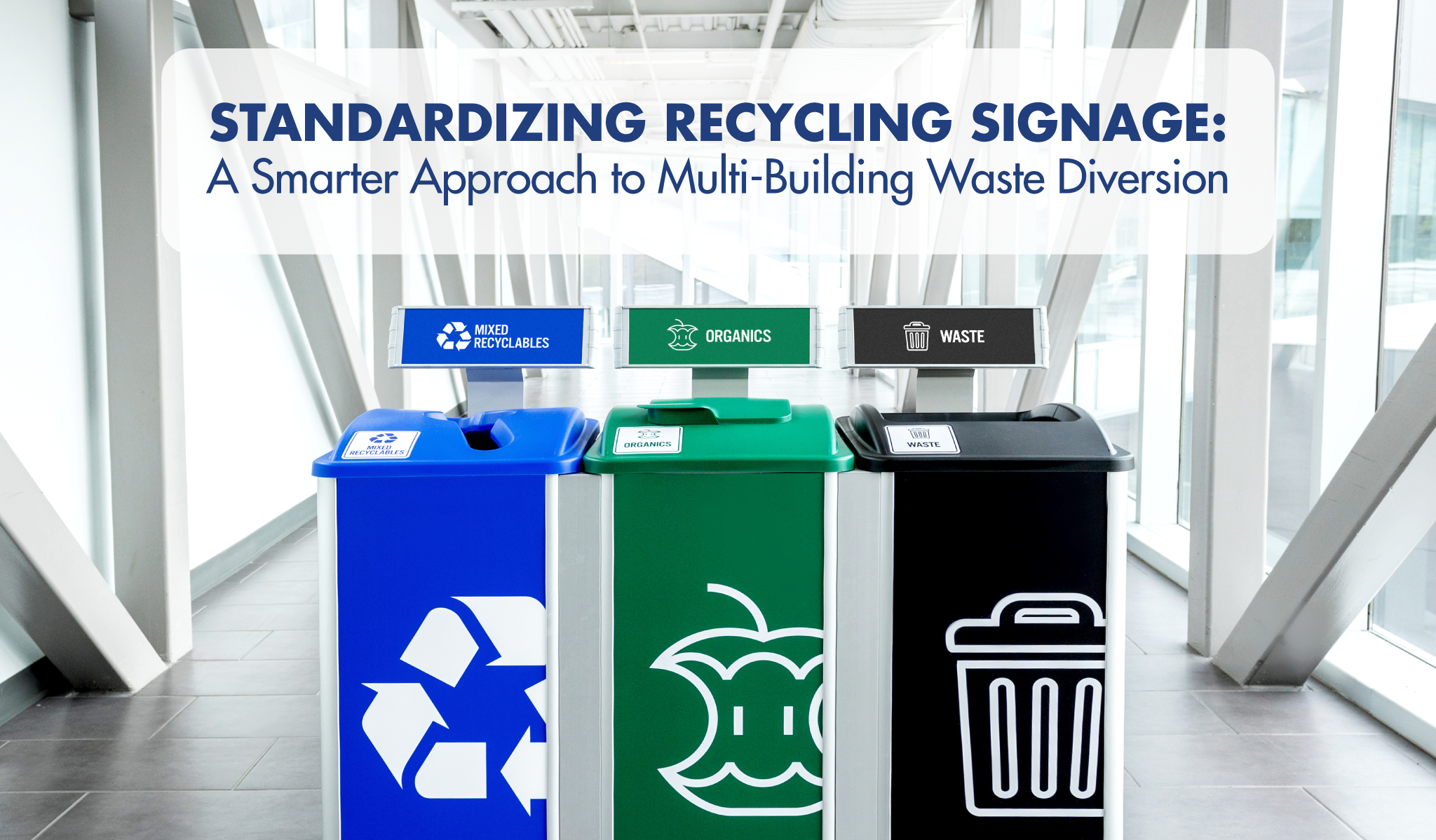
Assign a color to each waste stream and maintain it across every property.
For example:
| Waste Stream | Standard Color |
| Recycling | Blue |
| Organics | Green |
| Landfill | Black or Grey |
The exact color scheme matters less than using the same system consistently.
The U.S. EPA recommends keeping waste-stream colors consistent throughout a program and building.
This means a blue recycling label in Building A should communicate the same thing as a blue recycling label in Building B.
3. Icons and Imagery
Use recognizable icons and real-world images to reinforce the written message.
A recycling symbol alone may communicate that a bin is associated with recycling, but it doesn’t necessarily tell someone what belongs inside.
The Recycling Partnership’s research found that people benefit from clear information about what should and shouldn’t go into a recycling container. It also found that realistic images, logical grouping and literal language can make recycling information easier to understand.
For multi-site programs, the same visual system should be repeated across properties.
If a beverage can is represented by a particular image style on one floor, don’t switch to an entirely different illustration style in another building.
4. Sign Layout
Standardize where information appears on the sign.
For example:
Top: Waste-stream name
Middle: Color and icon
Bottom: Accepted materials
This creates visual predictability.
Research has found that consistent positioning of waste-sorting signs can improve sorting performance.
When users encounter the same layout repeatedly, they know where to look for the information they need.
Standardize the System, Not Every Word
Standardization doesn’t mean every sign needs to be identical.
This is particularly important for organizations managing facilities with different tenants, uses and waste streams.
A corporate office may primarily need to communicate recycling for bottles, cans and paper. A cafeteria may need separate instructions for food waste, containers and landfill. A manufacturing facility may have entirely different material streams.
The visual framework should remain consistent while the content is adapted to the location.
Modular waste stations can help facilities teams apply this approach in practice. The Evolve® Series, for example, provides a flexible foundation for creating consistent waste and recycling stations across multiple properties while adapting the number and type of streams to each location. For facilities with more complex multi-stream needs, the Mosaic® Series can help create a recognizable, organized station design while accommodating different recycling and waste configurations.
Think of it as a signage hierarchy:
Organization-wide standards
- Colors
- Fonts
- Icons
- Bin labels
- Waste-stream names
- General sign layout
Property-specific information
- Accepted materials
- Contaminants
- Collection instructions
- Special waste streams
- Contact information
This approach gives people the familiarity of a standardized system without forcing every property into the exact same recycling configuration.
Make Signs Decision-Oriented
The best recycling sign isn’t necessarily the one with the most information.
It is the one that helps someone make the right decision quickly.
The Recycling Partnership tested recycling education materials and found that overly detailed information can overwhelm users. Their research found that materials with approximately 20–25 points of information performed better than versions containing 45–50 points of information. They also recommend grouping materials into recognizable categories and pairing images with words.
For point-of-disposal signage, consider focusing on:
YES
- Plastic bottles
- Aluminum cans
- Paper
- Cardboard
NO
- Food
- Liquids
- Plastic bags
- Batteries
The exact list should reflect the facility’s collection program and the materials identified through waste audits.
The principle is simple: give people enough information to make the decision without making the decision harder.
Keep Recycling and Landfill Together
Standardized signage works best when the physical infrastructure supports it.
Recycling should not be easy to identify in one building but difficult to find in another.
For multi-building facilities, this means standardizing more than labels.
Where possible, establish consistent standards for:
- Bin placement
- Number of waste streams
- Bin colors
- Label locations
- Sign height
- Sign orientation
- Distance between recycling and landfill bins
Modular stations such as the Evolve® Series can help organizations maintain these standards across properties while adjusting configurations to suit individual spaces. Similarly, the Mosaic® Series can provide a consistent station format for facilities that require multiple waste streams.
The objective is to make the entire waste-sorting experience predictable.
Create a Multi-Site Signage Playbook
Once standards have been established, document them.
A signage playbook gives facilities teams, custodial staff, property managers and contractors a single source of truth.
It should include:
Visual standards
- Approved colors
- Fonts
- Logos
- Icons
- Photography or illustration style
Messaging standards
- Approved waste-stream names
- Accepted-material terminology
- Standard “yes” and “no” language
- Translation requirements, if applicable
Placement standards
- Recommended sign height
- Label placement on bins
- Sign orientation
- Recommended distance between stations
Implementation standards
- Approved signage templates
- Approved bin configurations
- Replacement procedures
- Version-control requirements
This becomes especially important when facilities are added, renovated or serviced by different teams.
Without a documented standard, inconsistency can gradually return.
Audit Existing Signage Before Replacing It
A complete signage overhaul isn’t always necessary.
Start by auditing what’s already in place.
Walk through each property and document:
- Waste-stream names
- Bin colors
- Signage designs
- Accepted-material messaging
- Icons and images
- Placement
- Condition of signs
- Differences between buildings
- Common contamination issues
Then identify where the largest inconsistencies exist.
This can also be paired with waste audits. If one property consistently experiences contamination from coffee cups, plastic bags or food containers, that information can help determine what messaging belongs at that location.
Standardization creates the framework; data determines where additional communication is needed.
Don’t Forget Digital Signage and Internal Communications
A standardized waste program shouldn’t stop at the bin.
The same terminology and visual language should appear across:
- Employee communications
- Tenant onboarding materials
- Facility maps
- Digital screens
- Sustainability reports
- Training materials
- Event signage
The Recycling Partnership recommends reinforcing recycling information across multiple touchpoints rather than relying on a single communication.
When someone sees the same recycling message in an employee handbook, on a cafeteria sign and at the point of disposal, the organization is reinforcing one consistent system.
Measure Whether Standardization Is Working
Standardizing signage is an operational change, so facilities managers should measure its impact.
Useful metrics include:
Contamination rate
Are fewer non-recyclable materials entering recycling streams?
Capture rate
Are more recyclable materials being diverted from landfill?
Diversion rate
Is the overall percentage of material being diverted increasing?
Service efficiency
Are custodial teams spending less time correcting sorting errors or servicing improperly used stations?
User feedback
Are employees, tenants or visitors reporting fewer questions about what goes where?
Before-and-after waste audits can help determine whether signage changes are actually influencing behavior.
A Standardized Signage System Scales With Your Organization
For a single building, inconsistent recycling signage may seem like a minor issue.
For an organization managing 10, 20 or 100 properties, it becomes a systems problem.
Every inconsistent label creates another opportunity for confusion. Every standardized station creates another familiar decision point.
Solutions such as the Evolve® Series and Mosaic® Series can support that consistency by giving organizations a repeatable foundation for waste and recycling stations across properties, while still allowing configurations and messaging to adapt to each facility’s needs.
The goal isn’t to make every facility look exactly the same. It’s to make the recycling experience feel familiar wherever someone encounters it.
When colors, terminology, icons, layouts and bin configurations work together, facilities managers can create a waste diversion program that is easier to understand, easier to maintain and easier to scale.
Standardization turns recycling signage from a collection of individual signs into an organization-wide system, and that system can become a powerful tool for improving participation, reducing contamination and strengthening diversion outcomes.
Building a More Consistent Waste Diversion Program
For multi-building organizations, signage is only one part of a standardized waste management strategy. Consistent bin configurations, modular stations, clear labelling and ongoing measurement can help facilities teams create a program that works across properties while still adapting to the needs of each location.
The right infrastructure makes it easier for people to make the right choice, and easier for facilities teams to manage that choice at scale.