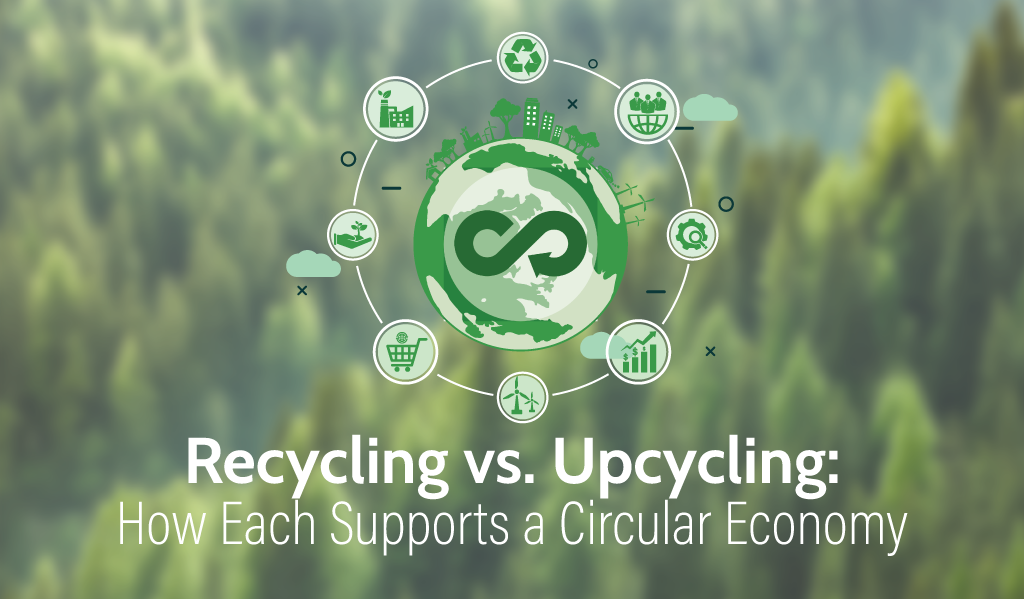
When we talk about creating a more sustainable future, recycling vs. upcycling is an important distinction to understand.
While they may sound similar, they represent two different approaches to keeping materials in use and reducing the amount of waste sent to landfill or incineration.
At Busch Systems, we believe waste diversion is about more than simply deciding which bin something belongs in. It is about rethinking our relationship with materials, how we use them, how long we keep them in circulation, and what happens when their original purpose comes to an end.
Both recycling and upcycling can play an important role in that process. Understanding the difference can help organizations make more informed decisions about waste reduction and move closer to a circular economy.
What Is a Circular Economy?
Our traditional economy has largely followed a linear model:
Take → Make → Use → Dispose
Raw materials are extracted, products are manufactured, those products are used, and eventually they become waste.
A circular economy looks at materials differently. Instead of treating products as disposable once they reach the end of their original use, a circular approach aims to reduce waste, extend product lifespans, reuse materials, and keep resources in circulation for as long as possible.
This can involve everything from designing products for durability and reuse to recycling materials into new products.
That is where recycling and upcycling come in.
What Is Recycling?
Common recyclable materials include:
- Paper and cardboard
- Glass
- Aluminum and other metals
- Certain plastics
- Electronics and other specialized materials
When recycling works effectively, materials that might otherwise be disposed of can re-enter the manufacturing cycle.
For example, used plastic can be processed into recycled plastic feedstock, which can then be incorporated into new products. At Busch Systems, we use post-consumer and post-industrial recycled plastics in select products, giving previously used materials another purpose while considering factors such as quality, performance, carbon footprint, and sustainability.
What Is Upcycling?
An old wooden pallet could become furniture.
A discarded glass jar could become a storage container.
Fabric scraps could become reusable bags.
An outdated piece of equipment might be repurposed for an entirely different application.
The defining idea is that the original material or product is given a new purpose without necessarily going through the conventional recycling process.
Upcycling can therefore help extend the useful life of a product while reducing the demand for new materials.
Recycling vs. Upcycling: What’s the Difference?
The easiest way to understand the difference is to look at what happens to the material.
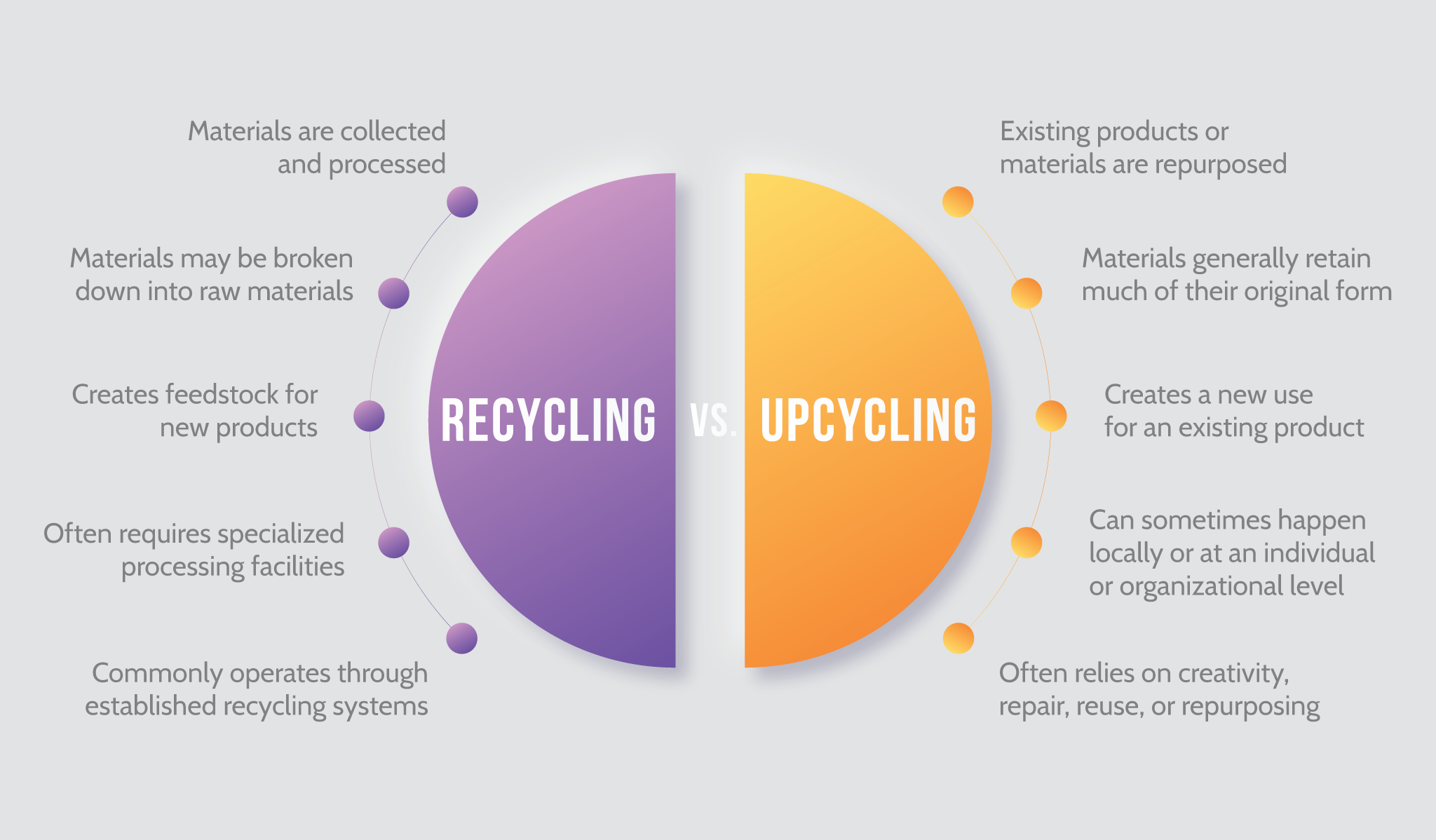
Neither approach exists in isolation.
A strong circular economy uses a combination of strategies to keep materials in circulation for as long as possible.
Where Does Reuse Fit In?
There is another important concept between waste reduction and recycling: reuse.
Before asking whether something can be recycled, organizations can ask:
Can we use it again?
Upcycling takes this concept a step further by finding a new purpose for something that may no longer be needed for its original function.
This is why circular economy thinking is not simply about increasing recycling rates. It encourages us to consider what happens before an item ever reaches the recycling bin.
Why Recycling Still Matters
With so much emphasis placed on reuse and upcycling, it can be easy to overlook the important role recycling continues to play.
Not every material can be reused indefinitely.
Effective waste diversion programs help keep recyclable materials out of disposal streams and in productive use. Busch Systems’ approach to waste diversion recognizes recycling alongside reuse, composting, and other recovery methods as part of a broader strategy for reducing waste.
The key is making sure recycling is done well.
A recycling bin alone does not create a successful recycling program. Organizations also need clear signage, convenient collection points, employee and public education, appropriate infrastructure, and ongoing program management.
When people understand what belongs in each stream, they are better equipped to participate correctly, helping improve both the quantity and quality of materials recovered.
Upcycling Can Start With a Different Question
Recycling often asks:
“Can this material be processed into something new?”
Upcycling encourages us to ask:
“Can this still be useful?”
That shift in perspective can be valuable for businesses, schools, municipalities, and other organizations looking for opportunities to reduce waste.
Before purchasing something new, consider whether an existing item can be repaired or repurposed.
Before throwing something away, consider whether another department, organization, or community could use it.
Before sending a material to recycling, consider whether extending its useful life is possible.
These questions may seem small, but they encourage a fundamental change in how we think about resources.
How Organizations Can Support a More Circular Approach
Moving toward a circular economy does not require an organization to completely overhaul its operations overnight.
Start by looking at where materials are entering your organization and where they are leaving.
1. Reduce What You Purchase
The most sustainable material is often the one that does not need to be purchased in the first place.
Look for opportunities to reduce unnecessary packaging, eliminate avoidable single-use items, and purchase durable products designed for long-term use.
2. Prioritize Reuse
Before replacing something, determine whether it can be repaired, refurbished, donated, or reused elsewhere.
Create internal systems that make it easier for employees and departments to share resources rather than automatically purchasing new ones.
3. Look for Upcycling Opportunities
Get creative about materials that no longer serve their original purpose.
Could an item be transformed into something useful? Could another department use it? Could it become part of a community donation or reuse program?
4. Build a Strong Recycling Program
When materials can no longer be reused or repurposed, make sure they have a clear path into the appropriate recycling stream.
That means providing convenient bins, clear signage, consistent labeling, and education around accepted materials.
5. Measure and Improve
A circular economy is not achieved through one initiative.
Organizations should continually evaluate their waste streams, identify opportunities for improvement, and use data to understand what is working and where materials are still being lost to disposal.
At Busch Systems, we believe successful waste diversion requires more than simply placing recycling bins throughout a facility. Program design, education, operational efficiency, and ongoing improvement all play a role in maximizing diversion.
Moving Beyond the Bin
Recycling and upcycling are sometimes presented as competing solutions, but they are better understood as different tools within the same larger system.
Upcycling can help extend the life of products and materials.
Recycling can recover materials that are no longer suitable for their original use.
Reuse can prevent products from becoming waste altogether.
And waste reduction can help minimize the resources we consume in the first place.
Together, these approaches move us away from a linear “take, make, dispose” model and toward a system where materials are viewed as resources rather than waste.
Our work has always centered around helping organizations maximize the quantity and quality of their waste diversion programs. Our sustainability approach also looks beyond recycling alone, from incorporating recycled content into products to measuring product carbon footprints and supporting broader circular economy practices.
The circular economy is ultimately about changing the question we ask about waste.
Instead of asking:
“How do we get rid of this?”
We can start asking:
“How can we keep this resource in use?” That change in perspective is where circularity begins.