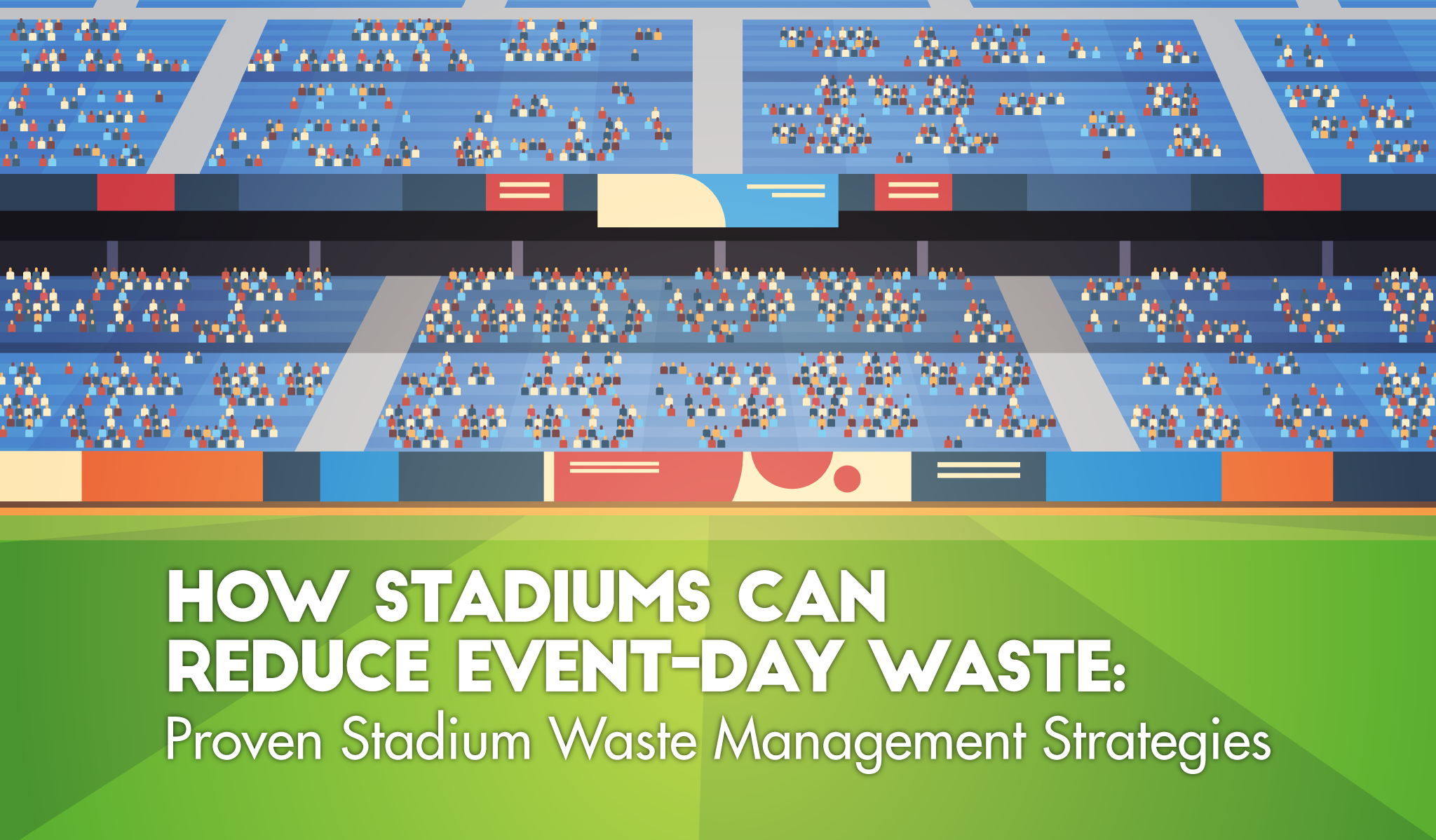
Stadiums are built for big moments. On event day, thousands of fans move through gates, concessions, suites, concourses, and seating areas in a matter of hours. That scale creates an equally significant waste challenge and makes effective stadium waste management essential.
From food scraps and beverage containers to packaging, promotional materials, and single-use items, the volume of waste generated during a single event can be staggering. But high waste volumes don’t have to mean high landfill volumes.
For stadiums and other high-traffic venues, effective stadium waste management starts with designing a system that works at the speed and scale of the event. The most successful programs combine infrastructure, clear communication, staff engagement, and ongoing measurement to make the right disposal decision easier for everyone.
And there is evidence that these strategies can deliver significant results. Across North America, stadiums and large entertainment venues have demonstrated that thoughtful waste diversion and stadium waste management programs can keep substantial amounts of material out of landfill.
Here are proven strategies stadiums can use to reduce event-day waste and build a more effective waste diversion program.
1. Design Waste Stations Around the Fan Experience
On event day, fans aren’t stopping to study a waste management plan. They’re looking for the closest, most obvious place to dispose of their waste.
That means waste stations need to be designed around how people actually move through a venue.
Place stations where waste is generated and where people naturally pause, including:
- Concession areas
- Entrances and exits
- Seating sections
- High-traffic concourses
- Restrooms
- Suites and hospitality areas
- Outdoor gathering spaces
The goal is to make disposal convenient without creating unnecessary clutter. When the correct bins are easy to find and positioned directly in the path of traffic, participation becomes a natural part of the fan experience.
For stadiums, choosing the right infrastructure is an important part of this equation. Waste and recycling stations need to accommodate high volumes while fitting naturally into the venue environment. Solutions such as Busch Systems’ Evolve® Series can be configured as standalone containers or combined into multi-stream collection stations, giving venues flexibility to build stations around different traffic patterns and waste streams.
Penn State’s Beaver Stadium provides a strong example of what can happen when recycling infrastructure is designed to make participation easier. Its “blue bag” initiative doubled recycling capture and collected 112 tons of recyclables in 2008.
The lesson is simple: infrastructure matters. Giving fans a clear and convenient way to participate can have a measurable impact on diversion.
2. Standardize Waste Stations Across the Venue
Consistency matters.
If a fan sees one configuration on the main concourse and an entirely different system near their seats, they have to relearn the disposal process every time. That creates uncertainty, and uncertainty can quickly lead to contamination.
Standardizing waste stations across the venue creates a familiar visual language. Consistent colors, labels, openings, and messaging help fans recognize the right disposal stream regardless of where they are in the stadium.
The Evolve® Series is designed with this type of flexibility in mind. With a variety of configurations, shapes, sizes, colors, lid options, graphics, and accessories, venues can create consistent collection stations while adapting the number of streams to the needs of different areas. As a recycling program evolves, streams can also be added, removed, or rearranged.
This standardization should extend beyond the bins themselves. Signage, labels, back-of-house containers, collection procedures, and staff training should all work together as one system.
Think of the waste station as part of the venue’s navigation strategy: it should be recognizable, intuitive, and consistent from one event to the next.
3. Make the Right Choice the Easy Choice
During an event, fans are distracted. They may be talking with friends, carrying food, looking for their seats, or trying to get to the next part of the venue. They don’t have time to stop and read lengthy instructions beside a bin; they need clear, simple guidance they can understand at a glance.
Effective waste signage should communicate the answer almost instantly.
Use:
- Large, easy-to-read labels
- Simple graphics and recognizable imagery
- Consistent colors
- Clear examples of accepted materials
- Distinct openings for different waste streams
- Minimal text
Instead of asking fans to determine whether something is “recyclable,” “compostable,” or “garbage” on their own, signage should clearly show what belongs in each stream.
Waste stations can reinforce that communication through their physical design. The Boka Series, for example, features 360-degree stream recognition around its openings, helping make the intended waste stream visible from multiple directions. In a busy stadium concourse, that type of visual recognition can help fans quickly identify where their waste belongs.
The Outlaw Series also offers restrictive opening options designed to support proper waste sorting, pairing clear disposal cues with a high-capacity 50-gallon container for busy indoor environments.
The best waste programs don’t just tell people what to do. They make the right choice easy.
That principle was demonstrated through the EPA’s GameDay Challenge, which brought together colleges and universities to reduce waste associated with sporting events. Participating schools collectively diverted more than 500,000 pounds of waste from landfill. Programs such as UC Davis combined fan education with clearly defined waste streams to help make proper disposal part of the game-day experience.
4. Focus on Contamination, Not Just Diversion
A stadium can have impressive diversion goals and still struggle with the quality of the material being collected.
Contamination occurs when materials are placed in the wrong stream. A recycling bin filled with food waste, for example, can compromise otherwise recyclable material and increase sorting costs.
For high-volume venues, contamination prevention should be treated as a core part of waste reduction, not an afterthought.
Start by identifying the materials that are most commonly discarded incorrectly. Then design the waste station, signage, packaging, and education around those materials.
This is where venue-wide standardization becomes especially valuable. When fans encounter the same disposal system throughout the stadium, they are more likely to develop consistent habits.
5. Get Concessions and Vendors Involved
Stadiums should work with food service providers, vendors, sponsors, and event partners to understand what materials are entering the venue in the first place.
Opportunities may include:
- Reducing unnecessary packaging
- Choosing recyclable or compostable food service items where appropriate
- Eliminating avoidable single-use materials
- Purchasing products with less packaging
- Standardizing packaging across vendors
- Clearly identifying which materials can be accepted through the venue’s waste streams
The simpler the material mix entering a stadium, the easier it becomes to manage after it has been used.
UC Davis provides a strong example of this systems-based approach. During its participation in the EPA’s GameDay Challenge, the university worked with its concessionaire to use recyclable or compostable packaging while also engaging students to help fans sort their waste correctly.
Waste diversion is ultimately a systems challenge. The front-of-house experience and back-of-house operations need to be designed together.
6. Train Staff to Support the System
Even the best-designed waste station can underperform if the people operating it don’t understand the program.
Event staff, custodial teams, concession employees, volunteers, and waste management teams all play a role in keeping materials in the right stream.
Training should cover:
- What belongs in each waste stream
- Common contamination issues
- How to answer fan questions
- Collection procedures
- What to do when bins become full
- How to identify recurring problems
Staff can also provide something signage can’t: real-time guidance.
During busy events, having employees or volunteers positioned near high-traffic waste stations can help fans make the right choice while also providing valuable insight into where confusion is occurring.
Staff training was an important component of the waste diversion program at PNC Music Pavilion. In 2019, the venue recycled more than 140,000 pounds and composted more than 91,000 pounds of material, while staff received sustainability training to support the program.
The takeaway for stadium operators is clear: infrastructure can create the opportunity for diversion, but people are essential to making the system work.
7. Plan for the Peaks, Not the Average
Stadium waste doesn’t happen evenly.
A waste station might sit relatively quiet for much of an event and then receive hundreds of items within minutes after a halftime rush or final whistle.
Designing a waste program around average traffic can leave stations overflowing precisely when waste generation is at its highest.
Instead, venues should consider:
- Event attendance
- Traffic patterns
- Concession sales
- Event schedules
- Intermissions and halftime
- Venue layout
- Historical waste volumes
Collection schedules and staffing should reflect these peaks.
The objective isn’t simply to have enough bins. It’s to have the right capacity, collection frequency, and staffing when and where they’re needed most.
High-capacity containers can help venues manage these fluctuations. The Evolve® Series is designed to hold more contents and reduce servicing frequency, while the Outlaw Series offers a 50-gallon capacity for high-volume indoor environments. By increasing capacity in areas with consistently high waste generation, venues can reduce the frequency of servicing while keeping collection points functional throughout an event.
8. Build a Connected Front-of-House and Back-of-House Strategy
What fans see is only one part of the waste system.
Behind the scenes, stadium kitchens, loading docks, concessions, maintenance areas, offices, and event operations can generate significant quantities of cardboard, food waste, packaging, and other materials.
These areas often require different infrastructure and procedures than public-facing spaces.
A strong program connects the two.
For example, if concessions are separating organics in the kitchen but those materials ultimately end up mixed with landfill waste during collection, the system breaks down.
Every material needs a clear path from the point of generation to its final destination.
This is particularly important for large venues where concession operations can generate substantial volumes of cardboard and food-related waste. Designing the back-of-house system alongside the front-of-house program helps ensure materials remain in their intended streams throughout the entire collection process.
The infrastructure used in these spaces should also reflect the demands of the environment. Durable, high-capacity solutions such as the Outlaw Series can support busy indoor areas while its body, made from 100% post-consumer recycled content, aligns with a broader focus on reducing the environmental impact of the waste infrastructure itself.
9. Use Waste Audits to Find Opportunities
You can’t improve what you don’t measure.
Waste audits can help stadium operators understand what they’re actually throwing away, rather than relying on assumptions about what fans are discarding.
An audit can reveal:
- Which materials make up the largest portion of the waste stream
- Where contamination is occurring
- Which waste stations are performing well
- Which locations need additional infrastructure
- Whether certain materials could be eliminated or recovered
- How event types affect waste generation
Importantly, audits should lead to action.
If an audit shows that a particular concession area generates significant amounts of a material that currently has no recovery pathway, that finding can inform future procurement decisions or program design.
The goal of measurement isn’t simply to produce a number. It’s to generate useful insights that make the next event better.
10. Use Data to Improve Stadium Waste Management
A successful waste diversion program isn’t something a stadium implements once and forgets about.
Event-day waste patterns change. Attendance changes. Vendors change. Packaging changes. Fans change.
Tracking performance over time allows venues to identify trends and make informed decisions.
Useful metrics can include:
- Total waste generated
- Diversion rate
- Recycling volume
- Organics volume
- Landfill volume
- Contamination rates
- Waste generated per attendee
- Waste station performance
- Collection frequency
Looking at waste per attendee can be particularly useful for comparing events of different sizes.
Real-world results show why this ongoing measurement matters. At CenturyLink Field, 94% of waste was diverted in 2018 across approximately two million guests and 185 event days. At iTHINK Financial Amphitheatre, 61% diversion was achieved during the 2019 season, diverting 166,910 pounds of material across 29 shows.
These examples demonstrate that high attendance doesn’t have to be synonymous with high landfill volumes. With the right systems in place, large venues can achieve significant diversion at scale.
11. Make Waste Diversion Part of the Event Experience
Sustainability doesn’t have to happen behind the scenes.
Stadiums have a unique opportunity to make waste diversion visible to thousands of people. Clear messaging on digital screens, concourse signage, announcements, social media, and event communications can reinforce the importance of proper disposal.
The key is to keep the message relevant to the experience.
Instead of overwhelming fans with statistics, venues can use simple calls to action:
Know before you throw.
Choose the right bin.
Keep recyclables out of the landfill.
Make waste diversion worth participating in.
Help us divert more waste from landfill.
When sustainability becomes part of the event identity, fans are more likely to see participation as part of being a responsible guest, not simply another rule to follow.
What High-Performing Venues Can Teach Us
The examples above point to an important conclusion: there is no single strategy responsible for a stadium’s waste diversion success.
CenturyLink Field’s 94% diversion rate, Penn State’s doubling of recycling capture, PNC Music Pavilion’s combined recycling and composting efforts, and the results achieved through the EPA’s GameDay Challenge all demonstrate the impact of taking a comprehensive approach.
Infrastructure matters. So does signage. So does staff training. So do procurement decisions, fan education, waste audits, and measurement.
Most importantly, these elements need to work together.
Stadium operators, in turn, need to select waste and recycling infrastructure that can support the program, not simply placing bins throughout the venue. Configurable, durable, and high-capacity solutions such as the Evolve®, Boka, and Outlaw Series can help venues create collection stations that align with their traffic patterns, waste streams, aesthetic requirements, and diversion goals.
Building a Waste Program That Can Handle the Crowd
Reducing event-day waste at a stadium isn’t about finding one perfect bin or launching one recycling campaign. It’s about creating a connected system that accounts for everything from procurement and concessions to waste stations, staffing, collection, and measurement.
The highest-performing programs make sustainable disposal the easiest option.
That means putting the right infrastructure in the right locations, communicating clearly, training the people who operate the system, and using data to continually improve it.
For high-volume venues, the opportunity is significant. Every event creates thousands of individual disposal decisions. When the venue makes those decisions easier, small actions can add up to meaningful reductions in landfill waste.
The future of stadium waste management isn’t simply about managing more waste. It’s about designing better systems so less waste ends up in the landfill in the first place.