Recycling programs are only as effective as the people who use them. Even organizations with ambitious sustainability goals can struggle to improve waste diversion when recycling infrastructure is inconvenient, confusing, or overlooked. While education and engagement play important roles, the design of the waste stations themselves can have a significant influence on how people dispose of their waste.
Premium waste stations offer an opportunity to rethink recycling infrastructure as more than a collection point. By combining thoughtful design, clear communication, strategic placement, and practical functionality, organizations can create environments that make recycling easier, more intuitive, and more consistent.
But what actually makes a waste station effective, and how can better design translate into greater recycling participation?
1. Design That Makes Recycling the Easy Choice
Recycling is often treated as a matter of awareness: if people understand why recycling matters, they will be more likely to participate. However, knowing what to do does not always translate into action. The convenience of the available infrastructure can influence whether people follow through on their intentions.
Research published in Resources, Conservation & Recycling examined recycling behavior in multi-residential buildings across Ontario. Researchers found that introducing recycling bins in building lobby entrances produced the greatest increases in recycling rates among the interventions studied, highlighting the importance of making recycling visible and accessible.
The takeaway is simple: recycling needs to fit naturally into people’s routines.
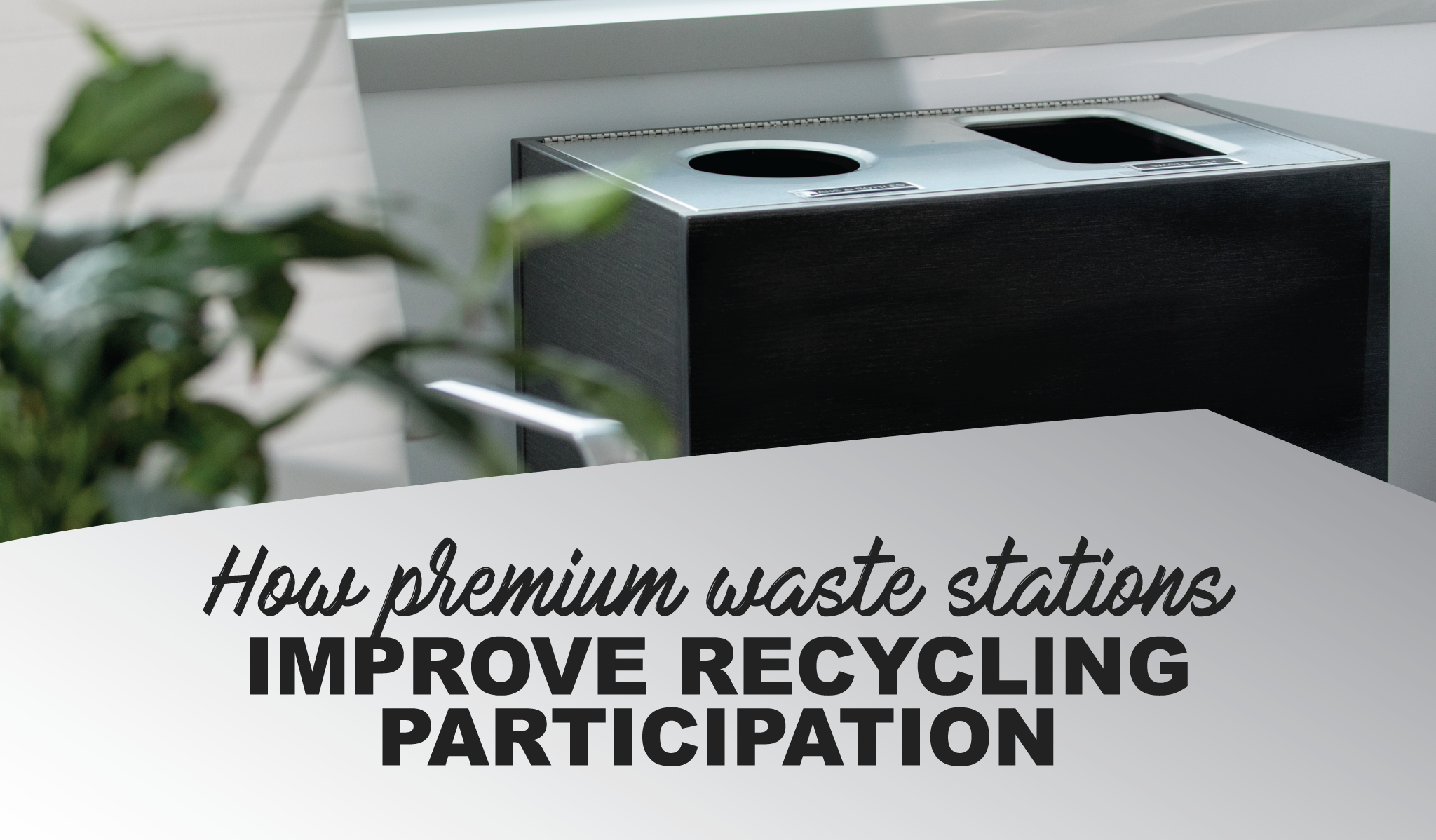
Premium waste stations can help remove barriers by consolidating waste and recycling streams into a single, accessible location. Instead of searching for a recycling bin or walking past multiple disposal points, users can sort their waste in one convenient place.
This is particularly valuable in high-traffic environments such as offices, educational institutions, healthcare facilities, airports, hospitality spaces, and multi-residential buildings. When recycling is integrated into the spaces people already use, participation becomes less of an additional task and more of an everyday habit.
2. Make the Right Choice Clear Through Design
A well-designed waste station does more than look professional. It helps users understand where their waste belongs.
When people encounter several disposal options, they often make decisions quickly. If recycling and landfill streams are difficult to distinguish, users may default to the most familiar or convenient option. Unclear sorting instructions can also lead to recycling contamination, reducing the effectiveness of an otherwise well-intentioned program.
Premium waste stations can address these challenges through coordinated colors, clearly differentiated openings, consistent stream placement, and intuitive labels.
Research published in the Journal of Environmental Psychology found that waste disposal signage featuring icons or pictures of accepted materials improved sorting performance compared with word-only labels in the experiments studied. Consistency in sign placement also supported better sorting.
These findings reinforce an important principle: effective waste station design should reduce the effort required to make the correct decision.
Rather than relying on users to interpret generic labels, organizations can create a more intuitive experience by incorporating recognizable visuals, straightforward instructions, and consistent design throughout their facilities.
For example, a station with clearly identified recycling, landfill, and organics streams helps users distinguish their options at a glance. Restrictive openings can provide another visual and physical cue, helping reinforce the intended use of each container.
The objective is not to overwhelm users with information. It is to communicate the right information at the moment it matters most.
3. Use Signage as a Tool for Behavior Change
Even a well-designed station can underperform if people do not understand what belongs in each stream. Signage bridges that gap by connecting the physical infrastructure with the behavior an organization wants to encourage.
However, effective signage is about more than adding labels or displaying sustainability messaging. It requires understanding the specific challenges users face.
Are people unsure whether disposable coffee cups are recyclable? Do they frequently place food-contaminated packaging in recycling? Are organics being discarded in landfill because the correct stream is not immediately recognizable?
Identifying these challenges allows organizations to develop signage that addresses actual disposal habits rather than relying on generic reminders.
We have explored this relationship through research and field testing, including a signage pilot conducted with the University of Georgia’s Office of Sustainability. The project examined different messages displayed at waste stations, including informational guidance, community-focused messaging, and explanations of how recyclable materials can become new products. Recycling performance improved across the study locations, although the small sample did not establish that one message was more effective than the others.
This illustrates a valuable lesson: improving recycling participation requires testing what works in a particular environment rather than assuming that one message will work everywhere.
Premium waste stations with integrated signage, sign frames, and adaptable labelling options make it easier to communicate with users at the point of disposal. Organizations can refine their messaging as waste audits reveal contamination trends, recycling guidelines change, or new materials are introduced.
The result is a waste station that supports an evolving recycling program instead of remaining a static piece of infrastructure.
4. Create a Consistent Experience Across Your Facility
Consistency is an often-overlooked part of effective recycling infrastructure.
Imagine walking into an office where recycling is identified by one color on the main floor and another color in the cafeteria. Or consider a university where the order of recycling, landfill, and organics streams changes from building to building.
Even when the correct disposal options are available, inconsistent layouts can introduce unnecessary confusion.
Standardizing waste stations helps establish recognizable patterns. When users become familiar with a particular color scheme, label format, and stream arrangement, they can apply that knowledge across different spaces without having to relearn the system.
For organizations operating multiple facilities, this consistency can also simplify staff training, waste management procedures, and future program expansions.
A premium waste station system can support this approach by allowing organizations to coordinate their infrastructure across offices, common areas, food service spaces, and other high-traffic locations.
Modular solutions are particularly useful because waste streams and collection requirements can change over time. Rather than replacing an entire station when an organization introduces organics collection or adjusts its recycling program, adaptable systems can allow configurations to evolve alongside operational needs.
The goal is to make the recycling experience feel familiar wherever people encounter it.
5. Align Waste Stations with Your Space and Sustainability Goals
Waste stations are a functional necessity, but they are also part of the built environment.
In workplaces, hospitality settings, healthcare facilities, and public spaces, waste stations contribute to the overall experience of a facility. Poorly placed or mismatched containers can disrupt the flow of a space, while thoughtfully integrated stations can support both operational needs and the surrounding design.
Premium waste stations give organizations greater flexibility to align their infrastructure with their environment without losing sight of functionality.
For example, a corporate office may prioritize a cohesive appearance that complements its interior design. A university may need durable, clearly labelled stations that accommodate large volumes of waste throughout the day. A hotel may prioritize stations that blend into guest-facing spaces while maintaining clear sorting instructions.
Busch Systems offers a range of solutions to meet these needs. The Spectrum Series features modular configurations, color options, embossed lids, and signage choices that allow organizations to tailor their waste stations to different spaces and collection requirements. For environments where aesthetics are especially important, the Aristata Series offers a refined approach to waste and recycling collection, helping organizations integrate waste stations into thoughtfully designed interiors. The Mezzo Series provides another option for organizations looking to combine a polished appearance with practical waste collection, making it suitable for spaces where both functionality and visual consistency matter.
By selecting a series that aligns with the needs of their facility, organizations can create a more cohesive disposal experience while making recycling infrastructure easier to recognize and use. Adaptable configurations and coordinated designs can also help maintain consistency across different areas of a building.
Premium does not simply mean choosing a more attractive container. It means considering how durability, functionality, adaptability, and design work together to support long-term waste diversion goals.
6. Measure Performance Beyond Appearance
Investing in premium waste stations should be part of a broader waste diversion strategy, not a substitute for one.
While thoughtful design can help reduce barriers to recycling, no station can independently overcome every challenge. Local recycling rules, collection infrastructure, staff engagement, and user understanding all influence program performance.
Organizations should therefore evaluate waste stations based on how effectively they support their broader objectives.
Waste audits provide a useful starting point. By examining the contents of landfill, recycling, and organics streams, organizations can identify common disposal errors, track contamination, and establish a baseline for improvement.
Other useful indicators include:
- Recycling participation: Are people making use of the available recycling infrastructure?
- Contamination rates: Are non-recyclable materials frequently appearing in recycling streams?
- Waste diversion: Is a greater proportion of generated waste being directed away from landfill?
- Operational efficiency: Are stations easy for maintenance teams to access, clean, empty, and service?
- User feedback: Do employees, visitors, residents, or other users understand how to sort their waste?
These measurements help organizations determine whether their infrastructure is meeting its intended purpose and where further improvements may be needed.
They also create opportunities to test changes. If an audit reveals persistent contamination in one stream, an organization might adjust its signage, reconsider the placement of its stations, or evaluate whether a different opening or configuration would better guide users.
By combining thoughtful design with ongoing evaluation, organizations can make more informed decisions about their recycling programs and demonstrate progress toward their sustainability goals.
Building Better Recycling Habits Through Better Design
Improving recycling participation requires more than asking people to make better choices. It requires creating environments that make those choices easier to understand and act on.
Premium waste stations can support this effort by bringing together accessibility, intuitive design, clear communication, consistency, and long-term functionality. When these elements work together, recycling becomes a more seamless part of everyday life.
For organizations looking to strengthen their waste diversion programs, the opportunity is to move beyond viewing waste stations as basic containers and start treating them as part of the overall recycling experience.
The most effective solution is not necessarily the most expensive or elaborate one. It is the one that addresses the specific needs of the space, makes correct disposal easier, and supports the organization’s long-term sustainability objectives.
At Busch Systems, we believe better waste management starts with thoughtful solutions that help people make better disposal decisions. By pairing the right infrastructure with clear communication and ongoing program evaluation, organizations can build recycling systems designed to work for both the people who use them and the environments they serve.