Across Canada, recycling programs continue to face a persistent challenge: contamination. When garbage, food residue, plastic bags, or other non-accepted materials end up in recycling, they can reduce the quality of recovered materials, disrupt sorting operations, increase processing costs, and send otherwise recyclable material to landfill.
Some Canadian communities have seen particularly high contamination rates. Regina recently reported that 18% of items placed in residential recycling carts did not belong there, nearly three times the program’s six-percent threshold. In Fernie, British Columbia, a 2024 curbside audit found 15% contamination. Toronto has also historically struggled with contamination, with city data showing that approximately 25% of material placed in the Blue Bin was non-recyclable in 2018, with projections exceeding 27% in 2018.
While these communities have different recycling programs and challenges, they highlight a problem that exists across Canada: recycling systems can only work when the infrastructure makes correct sorting easy.
Why Is Recycling Contamination Such a Problem?
It can be tempting to think that one wrong item in a recycling bin doesn’t make much difference. But contamination adds up quickly.
Food residue can soil paper and other recyclable materials. Plastic bags can become tangled in sorting equipment. Items that aren’t accepted by a particular recycling program may be removed during processing, or cause otherwise valuable materials to be discarded.
Toronto has specifically identified food waste, garbage, oversized materials, textiles, black plastic bags, and other non-accepted items as common sources of contamination. The City has also noted that contaminated materials can increase processing costs and result in recyclable material being sent to landfill.
The challenge isn’t always that people don’t want to recycle.
Sometimes, the system isn’t making the right choice obvious enough.
That is where better recycling infrastructure, signage, and education can make a measurable difference.
What Regina’s 18% Contamination Rate Can Teach Us
In March 2026, the City of Regina warned residents that 18% of items being placed in blue recycling carts were contaminants, well above the program’s six-percent maximum threshold. The City warned that continued contamination could result in additional waste fees, while contamination can also tangle machinery, slow operations, and cause recyclable materials to be discarded.
One of Regina’s key reminders is particularly important: recyclables should be placed loose in the cart rather than inside plastic bags.
Best recycling tip: Make the correct action obvious
When people are standing in front of a recycling bin, they shouldn’t have to stop and figure out what the program means.
Clear, visible signage can help answer questions before an item enters the wrong stream.
Instead of relying solely on a label that says “Recycling,” consider showing a small number of the most common accepted materials using straightforward language and recognizable visuals.
Busch Systems recycling stations, such as the Fusion Series, along with its recycling education and research resources, emphasize the importance of clear, prominent signage and messaging tailored to the specific contamination issues identified through waste audits.
The goal isn’t to give people more information. It’s to give them the right information at the right moment.
What Fernie’s 15% Contamination Rate Can Teach Us
Fernie, B.C., provides another example of how quickly contamination can become a program-wide concern.
Following an enhanced curbside recycling program introduced in 2023, a Recycle BC audit found 15% contamination in one area of Fernie’s curbside recycling program. The City described this as an unacceptable level and was required to take action to track and reduce contamination.
Interestingly, the program had also expanded the materials residents could recycle, adding items such as gable-top containers, frozen dessert boxes, paper cups and lids, tinfoil, and tetra packs. At the same time, residents were required to place recycling loose in the blue bin rather than inside plastic bags.
This illustrates another major source of contamination:
Recycling rules change, and people don’t always know about it.
Best recycling tip: Design signage around your actual program
There is no universal recycling list that works everywhere.
What belongs in a recycling bin can vary between municipalities, provinces, facilities, and collection systems. Even something that has a recycling symbol on it may not necessarily be accepted in a particular program.
That means recycling signage should be specific to the location and program, rather than relying on generic messaging.
We recommend considering the materials unique to each location and using signage to eliminate guesswork. Consistent colours, clear terminology, and visual representations of accepted materials can all help people make the right decision. Standardizing recycling signage across buildings and facilities can also help create a more consistent user experience, reducing confusion when people encounter different recycling stations.
What Toronto’s Contamination Challenge Can Teach Us
Toronto demonstrates how contamination can become a long-term challenge in a large, complex recycling system.
City data showed that approximately 25% of material placed in the Blue Bin was non-recyclable in 2018, with forecasts suggesting contamination could exceed 27% by the end of 2018.
Toronto has identified several recurring sources of contamination, including food waste, containers with food residue, textiles, and other materials that don’t belong in the recycling stream.
Today, Toronto’s recycling system has also undergone a major operational change. As of January 1, 2026, residential recycling collection transitioned to producer responsibility, with Circular Materials responsible for residential recycling collection and related services.
Best recycling tip: Put recycling and waste together
One of the easiest ways to encourage correct sorting is to make the correct choice convenient.
If someone has to walk across a room, or across a building, to find a recycling bin, they may simply use the closest garbage bin.
Centralized collection stations that place waste, recycling, and organics together allow users to make a choice at the point of disposal.
7 Best Recycling Tips to Reduce Contamination
Whether you’re managing a municipal program, office, school, retail space, healthcare facility, or public venue, the following strategies can help reduce contamination.
1. Know Your Biggest Contaminants
Don’t guess what’s causing your contamination problem.
Conduct a waste audit to identify the items most frequently appearing in the wrong stream. Then build your education and signage around those specific items.
If coffee cups are the problem, address coffee cups.
If food containers are the problem, address food residue.
If plastic bags are the problem, make that message impossible to miss.
2. Use Clear, Specific Signage
“Recycle Here” isn’t always enough.
Show people what belongs in the bin using recognizable words, icons, or images.
3. Make Recycling and Waste Easy to Compare
Recycling shouldn’t feel like a scavenger hunt.
Place recycling and garbage containers together whenever possible. Use consistent colours and visual cues so people can immediately distinguish between streams.
4. Make the Bin Part of the Message
The container itself can communicate how it should be used.
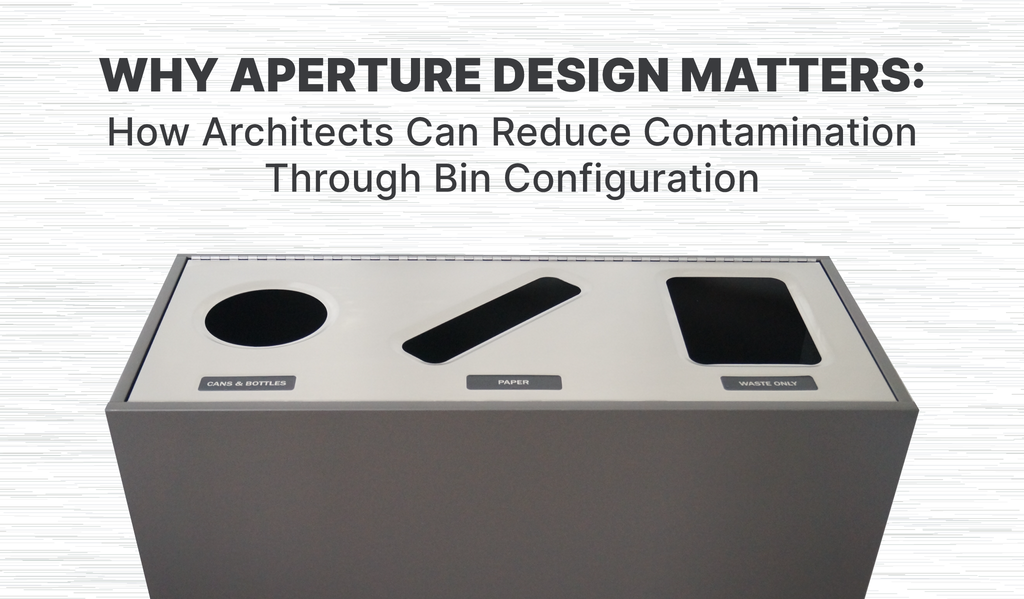
Restrictive openings, colour-coded streams, labels, and clearly identified collection points can all help guide users toward the correct stream.
For example, Busch Systems’ waste and recycling stations can incorporate stream-specific openings and signage to communicate what belongs in each container. A waste audit conducted at The Sandbox Centre in Barrie found that its Aristata stations used labelled, colour-coded streams and restrictive openings to help communicate accepted materials.
5. Keep Recycling Convenient
The further someone has to walk to find the right bin, the easier it becomes to choose the wrong one.
Place collection stations where waste is actually generated, near entrances, cafeterias, break rooms, printers, gathering areas, and other high-traffic locations.
6. Keep Signage Simple
More information doesn’t necessarily mean better information.
Instead of covering a sign with every possible recyclable item, focus on the materials users are most likely to encounter and the contaminants causing the biggest problems.
Busch Systems’ recycling experts recommend tailoring signage to the specific location and avoiding unnecessary jargon that can make sorting more confusing.
7. Audit, Adjust, Repeat
A recycling program shouldn’t be “set it and forget it.”
Waste audits can show whether contamination is improving, identify new problem materials, and reveal where signage, bin placement, or education needs to change.
The best recycling program is one that evolves with the people using it.
Better Recycling Starts With Better Design
The experiences of Regina, Fernie, and Toronto show that recycling contamination isn’t simply a matter of people not caring.
It can be the result of confusing rules, changing accepted materials, inconvenient bin placement, unclear signage, or collection infrastructure that doesn’t make the correct choice obvious.
The solution isn’t necessarily more bins.
It’s better-designed recycling systems.
From clearly labelled multi-stream stations to strategically placed collection points and customizable signage, the right infrastructure can help turn recycling from a guessing game into an intuitive part of everyday behaviour.
At Busch Systems, we believe successful waste diversion starts with making the right choice easy to see, easy to understand, and easy to make.
Because when recycling is designed around how people actually behave, better sorting, and better diversion can follow.
Ready to make your recycling program easier to use? Explore Busch Systems’ customizable recycling and waste containers and find a collection solution designed around your facility, materials, and diversion goals.