When organizations try to improve recycling or reduce contamination, they often start with the same playbook: brochures, websites, posters, and social‑media reminders. But as the insights make clear, information alone rarely changes behavior. People may know what to do, and even care about doing it, yet still sort incorrectly.
One of the most overlooked reasons?
Signage.
Not just any signage, but signage that is visible, targeted, behavior‑specific, and grounded in real human barriers.
Studies highlight how signage can either block correct behavior or unlock it. Here’s what the research and real‑world examples reveal.
1. When Signage Becomes a Barrier Instead of a Solution
In the Swarthmore College case study, students weren’t failing to recycle because they didn’t care. In fact, they were highly motivated. But they were surrounded by competing, cluttered, and confusing signage.
The study notes that:
Students faced “a lot of competition with other signage around bins,” which made sorting harder.
This is a classic behavioral‑design problem: when everything is shouting, nothing is heard.
2. The Power of Targeted, Behavior‑Specific Signage
Instead of adding more general recycling posters, the team redesigned signage to focus on only the items students were consistently getting wrong, such as clamshells, cold cups, and microwavable trays.
This is where signage becomes a behavioral tool, not just an educational one.
The new signage:
- Highlighted only the problem items
- Used 3D elements to make those items visually pop
- Gave clear, simple instructions for each confusing material
- Reinforced that “most people do the right thing,” leveraging social norms
This approach works because it aligns with how people make decisions in the moment: quickly, visually, and with minimal cognitive load.
Built for Better Communication: Fusion Series
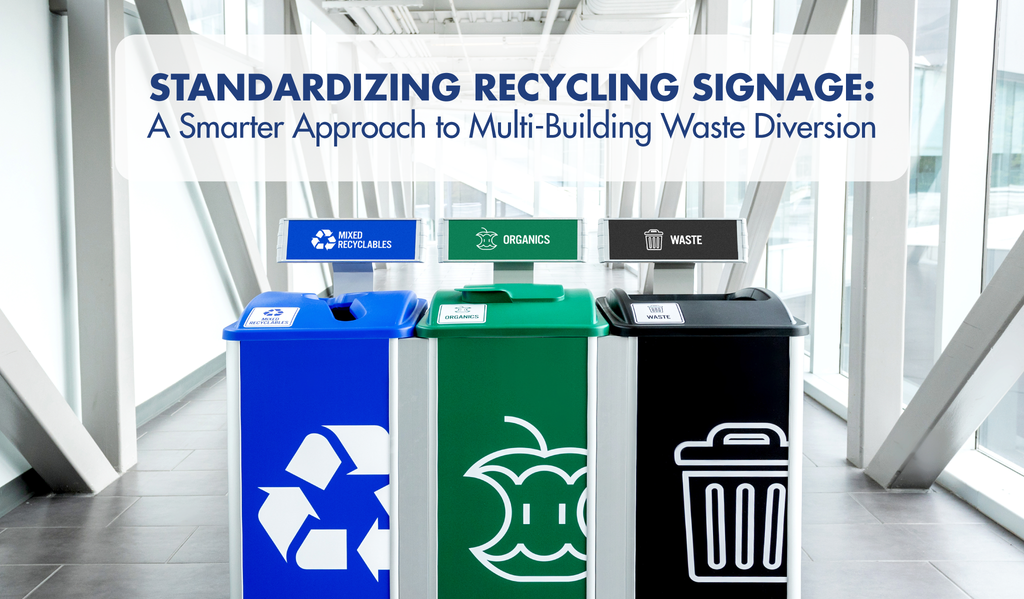
Effective signage starts with the bin itself. The Fusion Series features integrated full-panel signage that keeps recycling instructions highly visible and easy to update, making it simple to communicate stream information or wayfinding right where decisions are made.
Combined with single- and double-stream configurations, the Fusion makes it easier to deliver the right message exactly where people make their sorting decisions.
3. Signage That Reinforces Social Norms Works Better
One of the strongest findings in behavioral science is that people follow what they believe others are doing. The Fort Worth case study used this insight effectively.
Their bin hang‑tags didn’t just list what was recyclable. They also included a message showing that 87% of residents believed recycling was important.
This kind of messaging taps into a powerful motivator:
“People like me do this.”
When labels communicate that correct sorting is the norm, participation increases, even without additional incentives.
4. Signage Works Best When It’s Paired with Hands‑On Learning
At Swarthmore, signage was paired with a sorting game, where students practiced placing real items into the correct bins and received immediate feedback.
This combination, visual cues + physical practice, helps build habits faster than signage alone.
It also reinforces the idea that signage should be part of a multi‑touch behavior‑change strategy, not a standalone fix.
5. Signage Must Be Designed Around Real Barriers, Not Assumptions
One of the most important lessons is that signage should be based on actual audience research, not what program managers think people need.
For example, in Fort Worth, residents avoided recycling mixed paper because they feared their personal information would be visible. This wasn’t a real operational barrier, but it was a real psychological one.
The solution?
Signage that explicitly told residents they could cross out private information before recycling.
This is a perfect example of signage addressing a perceived barrier, which is often just as important as addressing a real one.
Prioritizing Communication: Waste Watcher® Series
For more than 15 years, the Waste Watcher® Series has helped campuses, municipalities, offices, and public spaces improve recycling participation through clear, consistent communication.
The redesigned series features an easy snap-together sign frame that allows organizations to quickly install or update messaging without tools. With stocked or fully customized signage options protected by a clear cover, Waste Watcher containers make it easy to keep recycling instructions visible, current, and aligned with changing waste programs.
When signage is easy to maintain, it’s more likely to stay accurate—and effective.
6. Good Signage Is Not About More Information, It’s About the Right Information
Across all examples, the most effective signage shared three traits:
- It was simple
Only the most confusing items were highlighted.
- It was visual
3D elements, real photos, and clear icons reduced cognitive effort.
- It was contextual
Placed directly on or above bins, at the exact moment of decision.
- It was normative
Messages reinforced that others were already doing the right thing.
- It was tested before scaling
Pilot testing revealed what worked, what didn’t, and what was most cost‑effective.
This is the opposite of the traditional “more posters, more text, more reminders” approach.
Designed for Higher Diversion: Mosaic Series
Effective recycling programs rarely stay static. As waste streams evolve, signage and collection systems need the flexibility to adapt.
The Mosaic Series was created with that flexibility in mind. Its modular design allows organizations to customize colors, lids, and signage while expanding capacity as programs grow. An elevated back sign frame increases visibility, helping users identify the correct stream from a distance, while customizable messaging allows facilities to target the specific items causing contamination.
By combining adaptable signage with modular collection, the Mosaic makes it easier to guide behavior and continually optimize diversion rates.
7. The Big Takeaway: Signage Is Behavior Design, Not Decoration
Signage is not just a communication tool ; it’s a behavior‑change tool.
When designed well, signage:
- Reduces cognitive load
- Removes confusion
- Reinforces social norms
- Makes correct behavior the easiest behavior
- Improves sorting accuracy
- Reduces contamination
- Builds long‑term habits
When designed poorly, signage:
- Overwhelms people
- Competes with other messages
- Increases confusion
- Fails to change behavior
The difference between the two is not budget; it’s strategy.
Final Thoughts
If you want to improve recycling or reduce contamination, don’t start with more brochures or more rules. Start with the moment of decision; the bin and design signage that:
- Solves real barriers
- Speaks visually
- Leverages norms
- Is tested before rollout
Signage is one of the simplest, most cost‑effective, and most scalable tools in the zero‑waste toolkit , when it’s done right.
Additional Resources
Guidance on Pre & Post-Intervention Surveys | Google Docs
(PDF) Differences Between Tight and Loose Cultures: A 33-Nation Study
Hidden Brain | Hidden Brain Media
Handbook of Wise Interventions: How Social Psychology Can Help People Change
Action Research | Sparking Behavior Change for Good