
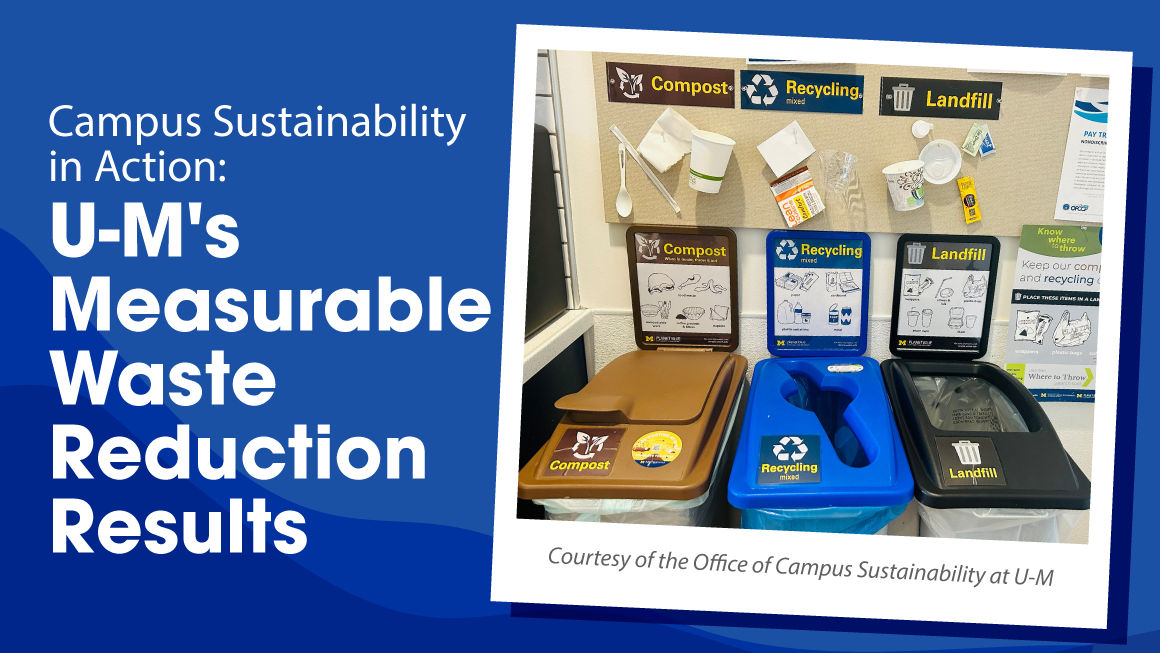
An article recently posted in The University Record and shared through the Waste Advantage Magazine Daily Newsletter highlights how the University of Michigan (U-M) is advancing campus waste reduction by pairing best practices with data-driven strategies that improve diversion and reduce contamination. Through a combination of standardized infrastructure, centralized collection, and strong engagement, U-M demonstrates how intentional program design and community participation can deliver measurable results.
We’re proud to see U-M leveraging standardized waste and recycling infrastructure, including Busch Systems Waste Watcher Series, to support these efforts and help drive measurable impact across campus.
Here are some of the main takeaways we saw in the article written by the office of the AVP for Campus Sustainability.
Standardized Bins & Signage
A key component of U-M’s waste reduction strategy is the standardization of bins and signage across campus. By removing non-standard containers and aligning bin design and signage with proven best practices, U-M reduced confusion and improved sorting behavior.
Design Features Driving Results
- Color-coded lids and signage to clearly differentiate waste streams
- Restrictive lids to guide correct sorting
- Custom signage featuring both words and images, paired with physical examples above bins to further reduce contamination
Impact: At the North Campus Administrative Complex, aligning with U-M’s bin standards resulted in a 70% increase in diversion.
Expanding Composting Programs
U-M expanded composting access across campus by introducing compost collection in new locations and integrating it with standardized waste infrastructure. Results included:
- Hatcher and Shapiro Libraries: a 40% increase in compost collection during a pilot program
- Walgreen Drama Center: a 380% increase in compost following the addition of standardized collection bins near student studios
These outcomes demonstrate that expanding access to composting can significantly increase the capture of organic materials and support broader campus diversion goals.
Centralized Collection Model
U-M tested a centralized collection model at the Ruthven Administration Building, replacing deskside bins with shared waste stations. Early findings highlighted measurable improvements across waste, recycling, and operations including:
- A 20% reduction in total waste generated across the pilot area
- An 80% decrease in recycling contamination
- A 28% increase in materials diverted to recycling & compost
- Approximately 9000 fewer plastic bags used annually through reduced plastic liner use
These results demonstrate that centralizing waste collection can drive significant operational efficiencies while increasing diversion and reducing contamination.
Expanding Impact Beyond Infrastructure
Beyond standardized bins and collection systems, U-M emphasizes community engagement and upstream waste prevention. Key outcomes from these efforts last year included:
- 500+ campus supported zero-waste events
- 12+ tons of student-move out donations collected
- $776,000 of lab material rehomed
- 800+ staff kitchens operating as zero waste spaces
Key Takeaways
U-M’s progress shows what’s possible when waste-reduction programs are built on clear, consistent systems and supported by strong campus engagement. By pairing standardized infrastructure, expanded composting, and centralized collection with behavior-informed design, the university achieved meaningful gains in diversion, contamination reduction, and overall waste reduction. It’s a clear example of how intentional program design — supported by the right tools — can drive lasting sustainability outcomes.
To learn more, read the full University Record Article here.