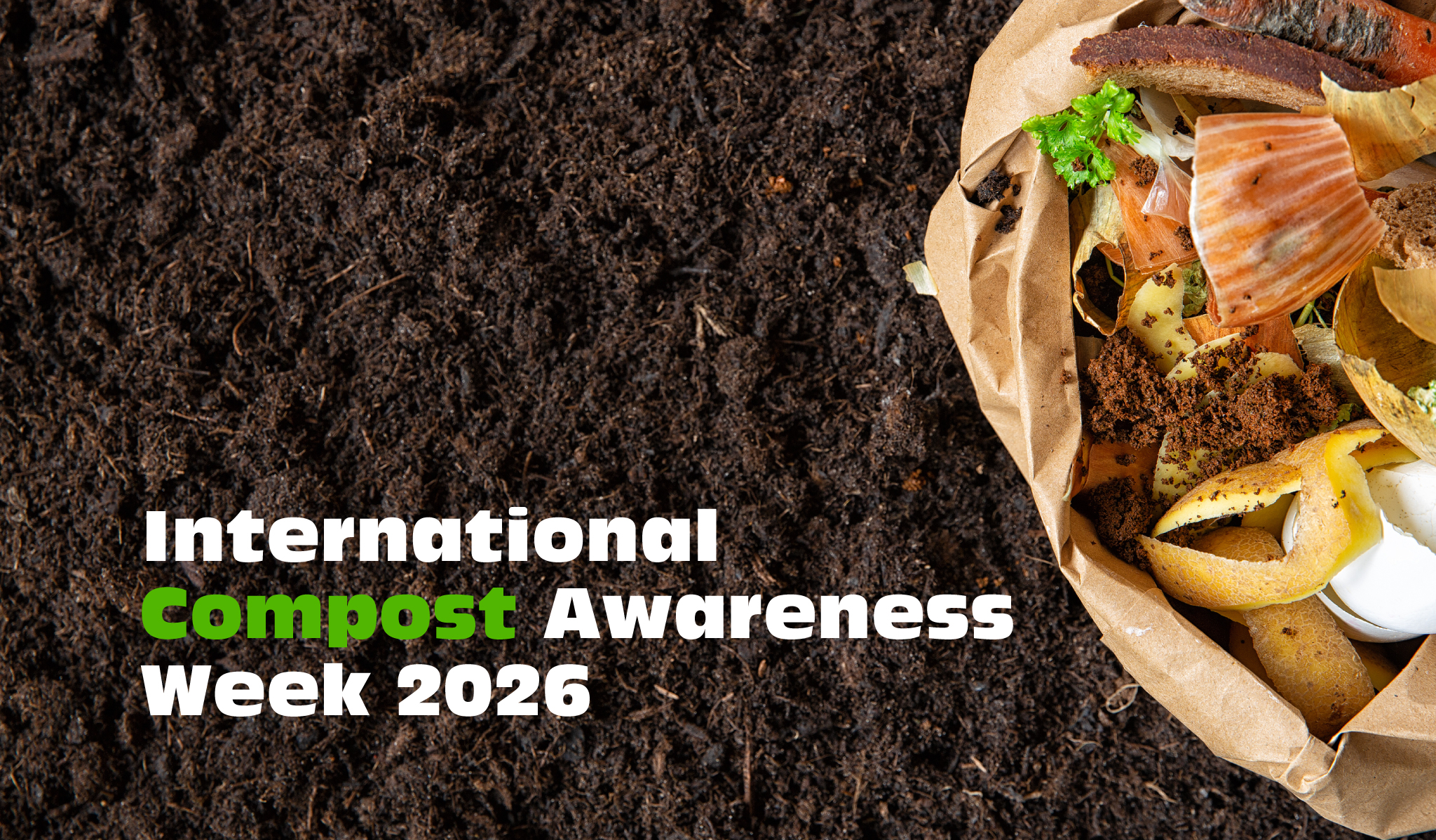
From May 3–9, 2026, communities around the world are celebrating International Compost Awareness Week, the largest global initiative focused on composting and organics recycling. Led by the Composting Council Research and Education Foundation, the week highlights a simple but important idea: when organic waste is returned to the soil, it supports healthier ecosystems, reduces landfill use, and helps build a more sustainable future.
The 2026 theme, “Compost! Feed the Soil that Feeds Us,” connects composting directly to soil health, food systems, and long-term environmental resilience.
At Busch Systems, this is something we think about year-round. International Compost Awareness Week is a reminder of how far organics diversion has come, and how much opportunity still exists to improve how systems work in practice.
Why Composting is Becoming Core Infrastructure
Composting is no longer viewed as a standalone sustainability initiative. Across North America, it is increasingly being integrated into the design and operation of modern resource management systems.
The focus is shifting from awareness to implementation. Most people already understand the importance of composting; the challenge now is how effectively systems enable participation at scale.
When organics programs succeed, they feel effortless and intuitive. When they fall short, it is rarely due to lack of intent. More often, it comes down to unclear guidance, inconsistency, and how systems function at the point of disposal.
Canada: Expanding Programs, Growing Expectations
In Canada, organics diversion is widely established and continues to expand.
Cities such as Toronto and Vancouver have made green bin programs a standard part of waste collection, with organics separation now embedded in everyday behavior for many residents and businesses.
At the provincial level, Ontario and British Columbia are continuing to expand Extended Producer Responsibility programs, shifting more responsibility upstream and influencing how materials are designed and managed.
Federal guidance from Environment and Climate Change Canada is also tightening around compostable labeling and contamination reduction, reflecting a stronger focus on improving the quality of material entering organics streams.
While infrastructure is strong in many regions, one of the ongoing challenges in Canada is consistency. Different municipalities can have different rules and systems, which makes clear, intuitive design at the point of disposal especially important.
United States: Rapid Growth Across a Regionally Varied System
In the United States, composting is expanding quickly, but through a mix of state and municipal programs rather than a single national approach.
California continues to lead with statewide organics requirements under SB 1383, which mandate food waste separation and set diversion targets for landfill reduction.
States such as Massachusetts and New York have also introduced commercial organics diversion requirements that are expanding over time.
At the city level, San Francisco remains a well-known example of a long-standing mandatory composting program, while New York City is actively scaling organics collection across a dense and complex urban environment.
The key theme in the U.S. is variation. With different rules across jurisdictions, organizations increasingly need systems that are simple, flexible, and easy to understand in any setting.
From Awareness to Action: What Actually Drives Results
International Compost Awareness Week effectively raises awareness, and the real opportunity lies in turning that awareness into simple, consistent action within everyday systems.
Across both Canada and the United States, successful composting programs tend to share a few common traits:
- Organics separation is clear and intuitive at the point of disposal
- Collection systems are easy to understand without interpretation
- Placement matches real behavior in workplaces, campuses, and public spaces
- Consistency across environments helps reduce confusion and reinforces proper sorting habits
When these conditions are met, participation increases naturally. When they are not, even well-intentioned programs can struggle with contamination and inconsistent diversion.
Building Better Organics Systems
The opportunity in composting today is not just expansion but improving how systems function in practice.
As programs scale across North America, the focus is increasingly shifting toward how organics systems are experienced by the people using them every day. The most effective programs provide clear direction at the point of disposal and make correct sorting intuitive.
At Busch Systems, this aligns with how we think about organics diversion and waste separation more broadly. The goal is not just participation, but systems that work reliably in real-world environments.
International Compost Awareness Week
International Compost Awareness Week continues to play an important role in highlighting the value of composting and organics diversion. As programs evolve across Canada, the United States, and beyond, the opportunity is increasingly shifting from awareness to execution.
The next phase of progress will be defined by how effectively systems are designed to work in practice, supporting clearer decisions at the point of disposal, and enabling more consistent participation across different environments.
Key Takeaways
- International Compost Awareness Week 2026 highlights composting as part of a broader soil and climate system
- Composting is becoming core infrastructure across Canada and the United States
- Policy and program expansion are increasing, but consistency remains a key challenge
- Success depends more on system clarity and usability than awareness alone
- The most effective programs make correct sorting simple and intuitive
Resources
Busch Systems Green Thinking Webinar – Expanding Food Waste Diversion Programs
Busch Systems Green Thinking Webinar – Organics Collection from Indoor Settings