
Managing waste in a healthcare setting can be challenging—but it’s also incredibly rewarding. Success requires consistent attention, awareness, and the development of daily habits among staff and patients alike.
You’ve probably heard the usual advice: standardize your program, add more recycling stations, reduce contamination. These are all important steps, but executing them effectively comes with many moving parts—that’s why your expertise is so valuable!
The team at Busch Systems has compiled a list of 9 free resources to help you run an efficient and effective recycling and waste management program in your healthcare facility.
1. How to Start a Hospital Recycling Program, Trash Cans Depot
This guide addresses the unique challenges of hospital recycling programs. It emphasizes forming a diverse committee to ensure all voices are heard, boosting staff buy-in. The guide also offers practical steps, like using clearly labeled bins and sustainable suppliers, to make recycling accessible to staff, patients, and visitors. Regular evaluations and department-wide consistency are key takeaways.
2. Guide to Starting a Hospital Recycling Program, Healthcare Plastics Recycling Council
Designed for hospitals integrating recycling into patient care areas, this guide walks you through starting a plastics recycling program—from initial planning and budgeting to implementation and improvement. It provides tools and insights for understanding the economic, regulatory, staffing, and infrastructure considerations involved.
3. Canadian Coalition for Green Health Care – Waste Management and Reduction
This is a comprehensive resource tailored to Canadian-healthcare settings, offering a full suite of tools, data and guidance for waste reduction, diversion and circular-economy strategies in hospitals and clinics. The page outlines how Canadian health-care institutions can reduce waste from biomedical, food, single-use and general waste streams and shift toward reduction, reuse, recycling and sustainable procurement.
4. Lessons Learned on Plastics Recycling in a Clinical Setting, Standford Health
This case study offers real-world strategies to reduce labor demands and contamination. Using data from waste audits and pilot programs, it demonstrates cost savings and provides practical insights into establishing a successful recycling program in any hospital setting.
5. Targeting Hard to Recover Waste in Healthcare, Busch Systems Webinar
This webinar explores challenges and solutions for reducing healthcare waste. Speakers analyze waste composition in community hospitals, share case studies, and discuss circular economy solutions. A panel discussion with a frontline nurse provides real-world perspectives on implementation.
6. Advancing the Circular Economy in Healthcare, Busch Systems Webinar
Focusing on single use supplies and packaging, this webinar addresses economic and safety concerns that have historically hindered recycling in healthcare. Case studies from UCLA Health and The Ohio State University Wexner Medical Center demonstrate practical approaches for reducing waste and promoting a culture of sustainability.
7. Introduction to an Intensive Care Recycling Program, NLM
This article highlights recycling strategies in intensive care units (ICUs). It emphasizes smarter product use, product lifespan extension, and quality improvement through the SusQI methodology. Behavior change models are also discussed to encourage staff participation in sustainable practices.
8. Case Study: Stanford Medical Center & the Healthcare Plastics Recycling Council about the possibilities of clinical recycling.
This comprehensive case study covers managing all types of healthcare waste: solid, regulated medical, recyclables, hazardous, controlled substances, universal, and construction debris. It provides guidance on measurement, cost management, compliance, and optimization, offering practical tips for sustainable and efficient waste management.
9. Healthcare LCA: A Database of Healthcare’s Environmental Impacts
HealthcareLCA provides environmental impact assessments for over 2,000 healthcare products and processes. Covering multiple regions and healthcare fields, this open-access database helps identify opportunities for improvement, supporting evidence-based decisions for sustainable recycling and waste management.
We hope these 9 free resources help you implement or improve the recycling and waste management program at your healthcare facility!
Additional Resources for your Healthcare Recycling Program
- Busch Systems Green Thinking Webinar: Advancing the Circular Economy in Healthcare (original air date January 25, 2024)
- Busch Systems Green Thinking Ask an Expert about Waste Reduction in Healthcare (original air date February 22, 2024)
- Busch Systems Green Thinking Webinar: Making an Actionable Plan (original air date June 13, 2023)
Suggested Recycling Containers for your Healthcare Recycling Program
Join the new era of healthcare waste management with expertly designed recycling & waste stations from Busch Systems.
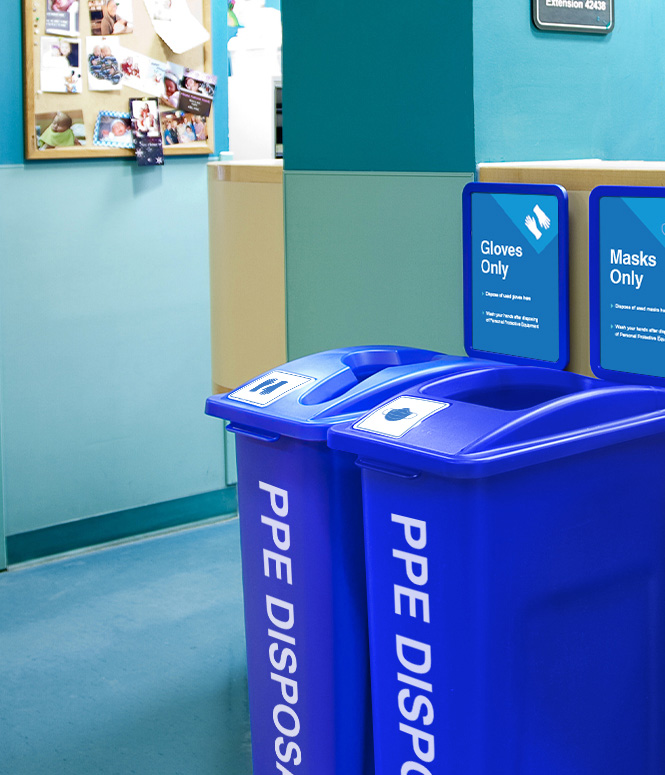
program in your healthcare or clinic facility
Key Takeaways (TL;DR)
Healthcare waste management is complex but rewarding. Success depends on staff engagement, awareness, and consistent daily habits.
Standard strategies matter: Standardization, clear labeling, recycling stations, and contamination reduction are essential.
Free resources simplify implementation: Busch Systems compiled 9 guides, case studies, and webinars to support hospitals and healthcare clinics in improving recycling and waste management.
Highlights from the resources:
- Program planning & buy-in: Form diverse committees, plan budgets, and ensure department-wide consistency.
- Practical tools: Templates, educational materials, and step-by-step guides make recycling easier for staff and patients including choosing the right recycling and waste containers for hospital waste.
- Case studies & webinars: Real-world examples show cost savings, contamination reduction, and strategies for hard-to-recycle materials.
- Specialty focus: Resources cover ICUs, plastics recycling, circular economy approaches, and intensive care settings.
- Environmental impact data: Open-access databases help assess sustainability and guide evidence-based decisions.
Overall goal: These resources provide practical guidance to create efficient, sustainable, and compliant healthcare recycling programs.